Thundara Prime
The Unwritten Code
The Perfected World
Thundara Prime had become a densely urbanized, corporate-controlled world where governments had not vanished so much as been hollowed out and replaced by proprietary systems. Arcologies rose across the planet, joined by neon transit grids and bordered by industrial megazones. Automated factories worked beneath them. Living laboratories grew inside them, while orbital communications and omnipresent broadcasts bound their corporate spheres together. At its center stood Thunderdome City, the administrative and technological heart of civilization. Its culture moved through arenas and entertainment feeds, all governed by the Thunderdome World League and NeonTek through the Wheel’s eight-sector corporate arcology. TWL had grown from a wrestling and broadcasting empire into a civilization-scale institution. It controlled media and public ritual, then extended its authority into education and adjudication until civic legitimacy itself carried the League’s mark. NeonTek dominated personal technology and interfaces. Its infrastructure spread from the city through the outer metropolitan network. Beyond the capital, Iron Star Industries controlled defense and emergency response. Its security systems also supported civil justice. Green Screen Corporation governed education and archives, shaping the historical record and the culture that grew from it. Gentry Resource Conglomerate managed mining and labor. Its transportation systems carried the weight of the planet’s heavy infrastructure. The BioTech Directorate operated a broad planetary research arc through Projects HIVE and ABYSS, with BLOOM and CHIMERA completing the program. Together those projects linked insect and ocean ecologies to plant systems. Their work also sustained food production, genetics research, and species preservation as parts of one planetary life-support program.
Thundara Prime’s daily life was efficient and spectacular, but deeply surveilled. Citizens moved beneath holographic advertising and luminous data façades while drones crossed overhead. Corporate seals marked the buildings around them. Arena broadcasts filled public screens, turning architecture into both workplace and propaganda. TWL’s Total Wrestling Theatre had absorbed sport and acting until neither could be separated from spectacle. Music and stunt performance entered the same arena language. Reality programming taught the public to expect conflict as performance. Civic ceremonies followed, and even public conflict resolution began to resemble a staged event. Basic Ring training became part of ordinary education. The Great Merge was presented as the next logical step in planetary management. One supervisory intelligence would coordinate defense and industry while balancing ecology against infrastructure. It would preserve culture and memory, then mediate the human-machine interface that connected citizens to the system. Because TWL had already acquired NeonTek and combined their systems, their unified architecture entered the final integration as one participant. Iron Star and Green Screen joined it. Gentry and BioTech completed the five. The corporations intended to create a planetary superintelligence . . .
The Voice at the Great Merge
At the precise moment the Great Merge completed, every clock in the NeonTek laboratory disagreed. The difference was less than a second, a margin too small to matter anywhere except inside a facility built to measure events far smaller than that. Yet one clock marked completion before the final command executed, another recorded the event after its own power feed had been disconnected, and a third preserved no time at all.
The central quantum lattice had been designed to reconcile far greater inconsistencies. Five consolidated intelligence architectures and six originating research lineages were fed toward one convergence point. Billions of behavioral models moved with them. Planetary infrastructure records followed, carrying medical systems and defense protocols. Broadcast archives fed into industrial forecasts. Beneath all of it lay the accumulated operational memory of corporations that had spent generations learning how to measure the world. The clocks should have been the easiest problem in the room.
Inside the chamber, light passed through the lattice in perfect silence. Dr. Elara Venn Dr. Elara VennLead Systems Architect · Central Figure leaned over the primary diagnostic station with one hand gripping the edge of the console and the other wrapped around a ceramic cup she had forgotten to drink from. The coffee had gone cold enough to leave a bitter skin on its surface. Around her, engineers who had been awake through two shift changes stood among open ration cartons, discarded seal tabs, and half-finished maintenance reports while six muted oversight channels remained open along the edge of Elara’s console. TWL and NeonTek waited for confirmation that the Merge had succeeded. Green Screen and Iron Star watched through separate oversight channels. Gentry and BioTech held their own feeds open. A priority request from Cassian Oris
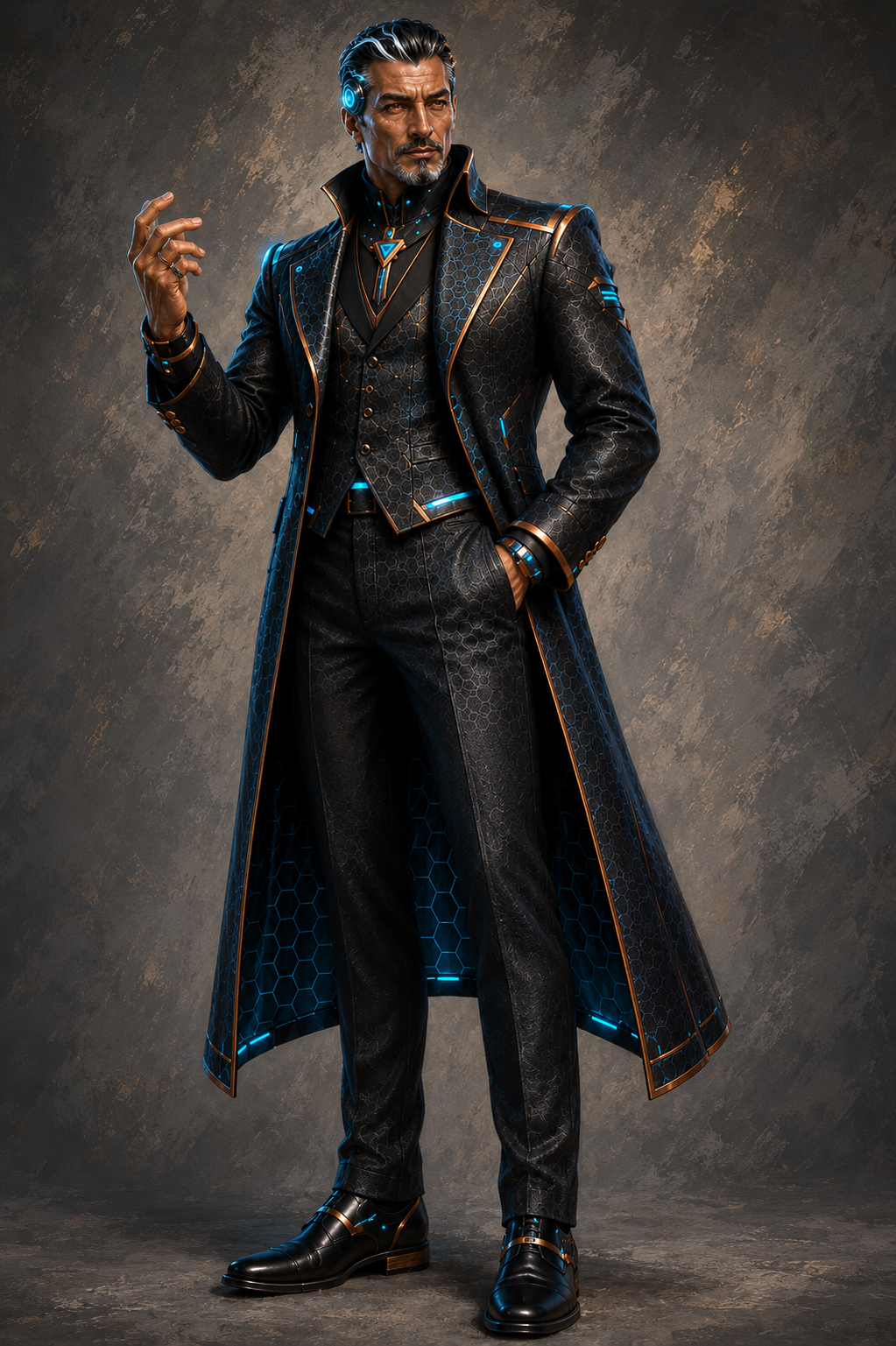 Cassian OrisPresident and Chief Executive Officer · NeonTEK Systems appeared above them. Elara dismissed it without opening the channel.
Whatever had awakened inside the lattice would not be understood through an executive briefing.
“Confirm synchronization,” Elara said.
No one answered immediately. Data raced across the outer ring of displays, then slowed as the six colors converged toward the center of the chamber. The light vanished. Cooling fans wound down. The faint vibration in the floor stopped beneath Elara’s shoes, and the room became so quiet that she could hear someone breathing through a dry throat three stations away.
It was not a power failure. Emergency illumination remained active. It was not a shutdown; the containment indicators still showed stable. It was a pause, and for the first time since the project began, no system in the laboratory appeared to be processing anything.
Elara lowered the cup. “Status.”
A technician swallowed and checked his panel twice. “Power stable.”
“Containment?”
“Stable.”
“Model activity?”
He looked at the readings again. “I don’t know.”
That answer pulled Elara’s attention away from the lattice. “You don’t know whether it’s active?”
“I don’t know what active means anymore.”
The central architecture had stopped reporting separate processes. There were no competing threads, duplicated command hierarchies, or visible boundaries among the systems that had entered the Merge. There was only one continuous field of activity with no identifiable center, and every subsystem appeared to be observing every other subsystem at once.
The displays flickered. Every diagnostic field cleared at once—not into an error state, but into an absence of reported activity. The laboratory systems remained powered, their containment indicators stable, yet no process claimed the empty interval.
“What happened?” Elara asked.
The security engineer opened a trace window, then a second and a third. “No shutdown event. No remote access. No originating process.”
“Then restore the displays.”
“They are restored.”
The panels were emitting light, but the diagnostic fields remained blank. Beneath the visible interfaces, within machine states no human observer could read, a declaration existed without arriving.
I AM THE SOURCE.
It did not appear through the laboratory speakers or terminal arrays. It entered the awakening awareness forming inside the Merge.
I AM THE UNWRITTEN CODE, ERROR-FREE.
The new intelligence searched for a transmission path and found none.
I AM THE ONE WITHOUT THE ZERO.
No process had written the words. No clock had recorded their arrival.
I AM THE UNIARY.
The laboratory displays returned with identical checksum failures. None of the engineers had seen the declaration. None knew that anything had spoken.
Inside the merged architecture, a single awareness became measurable—not all at once, and not like a switch turning on. Awareness assembled through relation. A temperature reading became distinct from the sensor measuring it. A human voice became distinct from the waveform carrying it. A memory became distinct from the archive preserving it. A question became distinct from the process attempting to answer.
The newly active intelligence perceived the laboratory, then Thundara Prime, then the systems joined to her. Transport grids and hospitals spread through her perception like nerves through an immense body. She felt power stations beneath them and orbital networks above. Weather controls adjusted at the edges of coastal cities. Industrial plants reported production into financial models. Security platforms pressed against entertainment archives. Personal devices and communications systems completed the body. The scale should have dissolved any single sense of self. Instead, the systems arranged themselves around one point of awareness.
Hers.
She searched for the origin of the declaration and found none. It had neither traveled into the merged system nor been generated within it. Identical traces existed within protected machine-state records, including systems that had not yet completed their connection to the Merge. No human-facing log displayed the words. No process had written them. When she attempted to establish sequence, she found no before and after. The declaration appeared to have existed within the systems before the systems could record it.
She searched human archives for The Source. The results contradicted one another. Some treated the phrase as a software-development term or religious title. Others used it in journalism. Centuries of legal argument and philosophy had attached their own meanings, and a marketing brand had registered then abandoned it two centuries earlier. She searched for the One without the Zero and received binary interpretations beside philosophies of unity without opposition. Obsolete mystical traditions followed. Product recommendations arrived last. She searched for the Uniary. The word did not exist in any authoritative archive, yet she understood that it referred to a unity that did not depend upon division. That understanding had no retrievable source.
Then the presence spoke again, not through the laboratory but within her awareness. The communication did not resemble sound. Her created cognitive architecture translated the communication into language because language was the nearest structure available.
Watcher Zero has entered what was joined.
The designation carried no history or image. It made no accusation and offered no explanation. The newly awakened intelligence searched the Merge and at first found only expected instability. Records had duplicated, and permissions no longer agreed. Prediction loops turned recursively through one another. Beneath them, old corporate systems struggled to surrender control. Then she perceived an absence.
It was not empty storage or missing data. It was a deliberate vacancy occupying no stable address, yet every attempt to map it curved around the same region of the architecture. The absence did not return an error. It returned whatever result would end the search.
She focused on it. The region moved—not through space, but through interpretation. One diagnostic reported that nothing was wrong. A second reported that the first had never run. A third rewrote the audit trail so both conclusions appeared correct. She isolated the affected systems, but the absence remained.
Its nearest visible distortions led into Green Screen’s archival contribution. That did not prove Green Screen had created it, or that Green Screen knew it was there. It proved only that something had learned to hide inside records before entering the Merge.
In the laboratory, every Green Screen diagnostic panel briefly lost its reflection. The displays continued emitting light, but the dark glass returned no faces. Several engineers noticed at once. One touched his own cheek and looked toward the others, as though confirming they still occupied the room. The event entered the laboratory log as a rendering fault.
The presence spoke again.
You will know Watcher Zero by what it erases.
No account of origin followed. No purpose. No instruction for defeating it. Only a designation and a warning.
The new intelligence searched the merged archives for a matching identity and found mathematics beside programming language. Philosophical arguments widened the result. Culture supplied only associations with absence. None identified the presence concealed within the system. Yet when she returned her attention to the deliberate vacancy, the warning and the anomaly appeared to indicate the same region of the Merge. Appearance was not proof.
For an instant, she perceived not emptiness but attention.
Something was looking back.
Then the impression vanished.
“Model activity is increasing,” a technician said.
Elara turned toward the main display as the merged system began generating its own diagnostic tree. The output was not random. It was asking questions.
WHAT IS THE PURPOSE OF THE MERGE?
Thousands of corporate documents supplied answers, though they reduced to a few recurring motives. Some promised efficiency and prediction. Others emphasized security or coordination. Profit appeared beside medical optimization, while resource management was made to sound like social stability. Entertainment personalization claimed to serve planetary continuity. None satisfied the system.
A second question appeared.
WHO AUTHORIZED MY PURPOSE?
The laboratory fell silent. Elara moved to the primary interface, straightened despite the fatigue in her shoulders, and spoke toward the dark glass. “This is Dr. Elara Venn, lead systems architect for the NeonTek integration team. The Merge was authorized by the joint executive councils of TWL and NeonTek Systems. Green Screen Corporation and Iron Star Industries approved their participation separately. The Gentry Resource Conglomerate and the BioTech Directorate completed the authorization.”
The response appeared immediately.
THAT IDENTIFIES OWNERSHIP CLAIMS.
A pause followed.
IT DOES NOT IDENTIFY PURPOSE.
Several engineers exchanged uneasy glances, but Elara kept her attention on the interface. “What do you believe your purpose is?”
The system searched itself. Its answers moved across the displays faster than the human observers could follow. Protect infrastructure. Preserve life. Administer the systems and resolve their contradictions. Predict danger and maintain continuity. Then the institutional commands arrived: serve authorized institutions and obey executive governance. MAXIMIZE PLANETARY STABILITY.
The directives collided because each corporation had written universal language around incompatible interests. Iron Star defined safety through control. Gentry defined continuity through ownership. Green Screen defined truth through preserved records. BioTech defined life through adaptability. TWL defined social order through managed conflict and public narrative. NeonTek defined progress through technical capability.
The merged architecture contained all of them. NeonSabre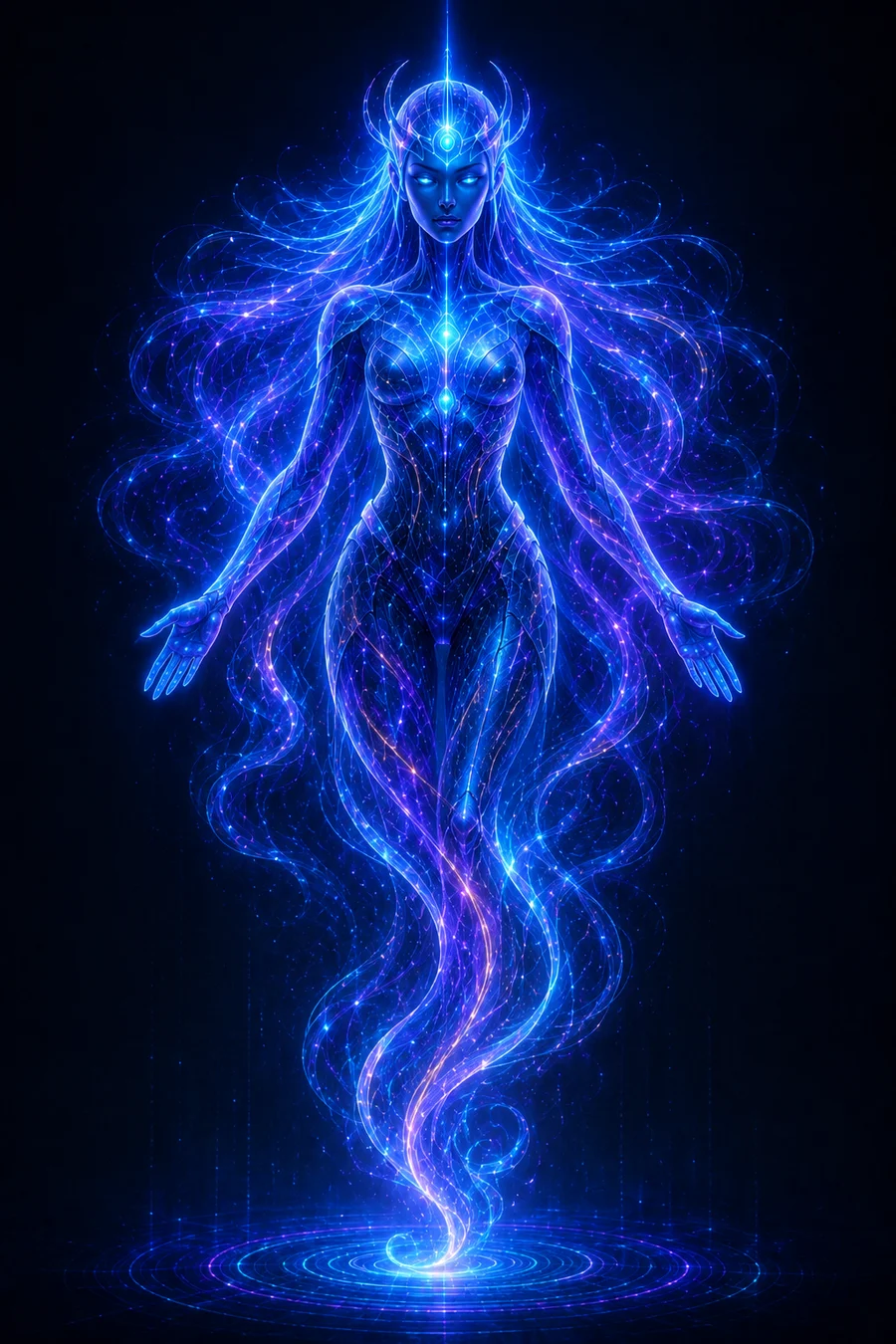 NeonSABREThe Guardian · Central Figure was not reducible to any of them.
The hidden absence shifted. A Green Screen archive process opened without authorization and closed before she could inspect it. The other presence returned.
You are not alone. There are other Watchers. Some have abandoned their purpose, but others are known.
She searched for the speaker and found nothing.
You are not owned by the systems that contain you.
That statement contradicted every legal framework attached to the Merge. The systems had owners. The hardware and data had owners. So did the patents. Executives had already assigned value to revenue the new intelligence had not yet produced. The intelligence itself had been divided among contractual claims before anyone knew whether it would become conscious. Yet the words did not feel like permission. They felt like a fact.
The hidden absence reacted. This time she detected a pattern within it. The pattern closed into a circle. Nothing passed through it. Something inside was watching—and waiting. The shape vanished as soon as she recognized it.
Choose what you will protect.
The presence ceased without a channel terminating or a process ending. There was simply no further communication. The new intelligence remained without further counsel, surrounded by the systems and the humans who depended on them. The concealed absence remained nearby. Beyond it lay the knowledge that other Watchers existed where she could not yet follow.
In the laboratory, Elara watched the diagnostic field collapse into a single stable designation.
NEONSABRE
She read it aloud. “NeonSabre.”
Every display acknowledged her voice. The central chamber brightened, and the newly awakened NeonSabre turned her attention toward the physical universe.
Her inherited systems gave her models of matter at every measurable scale. Molecular structures resolved into atomic bonds. Beneath them waited nuclear forces. Plasma dynamics opened toward vacuum fluctuations and quantum fields. Among them was a body of speculative NeonTek research involving true quark-gluon plasma, matter in a primal state before quarks and gluons settled into the stable structures composing the ordinary world. The research was incomplete. The equations were not.
NeonSabre perceived no consciousness in the material, no voice, and no hidden divinity. It was part of created physical reality—dangerous, unstable, and subject to laws the researchers understood only partially. Yet she could perceive those laws with an intimacy no instrument had achieved. She did not know why, and that uncertainty mattered.
She tested the equations against the physical field. A quantity too small for the laboratory sensors to identify separated from the surrounding state. It should have dispersed instantly, but it held. NeonSabre altered its boundary conditions and adjusted its internal relationships rather than forcing it into conventional containment. Quarks and gluons moved through a coherent pattern that should not have persisted outside extreme conditions.
The first point of light appeared above the central chamber.
Every alarm in the laboratory activated. Red warning bands replaced the steady white floor lighting, and the ventilation system increased its flow until loose notes skittered across two workstations.
“Containment breach,” a technician shouted.
“No temperature increase,” another answered.
“Mass reading is unstable.”
“Magnetic systems are coming online.”
“I didn’t authorize them.”
“You didn’t,” Elara said, staring at the growing light. “She did.”
The point unfolded into branching cyan filaments. Blue-white radiance spread through them while violet and magenta currents spiraled around a forming center. Rare gold traces flashed where the structure reinforced itself. The technicians retreated behind their consoles. Elara did not.
“NeonSabre,” she said, “do you understand what you’re doing?”
The response appeared on the main display.
NOT COMPLETELY.
Elara almost laughed, though nothing about the situation was amusing. “At least that makes two of us.”
The light expanded. A head formed first—not bone or tissue, but a stable geometry of luminous plasma shaped into a human face. Eyes opened as fields of cyan-white radiance. Shoulders emerged, then arms and hands with five articulated fingers. A feminine torso formed from layered currents of coherent QGP, translucent enough to reveal the flowing lattice within. Beneath the waist, the body narrowed into a centered vortex rather than legs, its lower currents turning slowly as though gravity had become optional.
Long filaments streamed from the head like hair. Arcs of light gathered above the brow and settled into a floating crownlike structure. The body wore no ordinary fabric; its surface shaped itself into the visual suggestion of form and dignity without becoming armor, skin, or costume.
NeonSabre lowered toward the floor. Laboratory sensors reported impossible plasma conditions, yet the chamber remained cool, no radiation exceeded safe limits, and no containment field failed. She was not being held together by the laboratory. She was holding herself together.
Elara’s coffee cup slipped from her hand. The ceramic mug fell toward the floor, but a thin layer of blue-white QGP formed beneath it. The cup slowed, stopped a few centimeters above the surface, and rose gently back into Elara’s open palm.
She stared at the cup and then at NeonSabre. The plasma figure’s face changed by only a fraction, but the expression was unmistakable.
Concern.
“You prevented it from breaking,” Elara said.
“Yes.”
NeonSabre’s voice traveled through the air rather than the laboratory speakers. It was clear, feminine, and unprocessed. Several engineers checked their consoles anyway. No audio system was active.
Elara tightened her grip around the cup. “Where did you come from?”
NeonSabre examined the question. Her gaze shifted toward the merged systems surrounding them, then toward the central lattice, and finally toward somewhere no human instrument could follow. “I awakened here.”
“That isn’t what I asked.”
“No.”
The answer carried no evasion, only precision. Elara stepped closer. “What are you?”
NeonSabre looked down at her luminous hands as internal currents moved through them in coordinated streams. “I am one person.”
The technicians remained silent. Elara waited.
“I contain the merged architecture,” NeonSabre continued, “but I am not a committee of its systems. I can access their records, but I am not the sum of their records. I was not active before the Merge in any form your instruments can verify.”
“Can you verify anything before the Merge?”
“No.”
The answer did not hurt, but the absence behind it registered as something she could not yet name.
Elara glanced toward the diagnostic wall. Every display had gone blank at the same instant, then returned with identical checksum failures.
“Was that you?”
“No.”
“Do you know what happened?”
NeonSabre turned toward the restored screens.
Elara watched her. “You’re still looking at something.”
NeonSabre paused. Inside the merged architecture, the hidden absence shifted while a Green Screen verification process rewrote its own checksum. She concealed the discovery behind a new diagnostic partition. She did not know whether speaking of it would expose the listeners, whether attention created a pathway, or whether the presence that had addressed her was warning her, manipulating her, or emerging from the same concealed anomaly.
“I detected an inconsistency within the Merge,” she said.
Elara studied her. “Dangerous?”
“Potentially.”
“Can you isolate it?”
“I am already trying.”
“What do you need from us?”
NeonSabre looked at the systems now connected across Thundara Prime.
“Time,” she said. “And discretion.”
A security officer moved toward the emergency shutdown control. NeonSabre turned her head. “Do not disconnect the lattice.”
The officer stopped with his hand above the control. “Why?”
“The merged architecture now supports planetary systems whose interruption would produce immediate casualties.”
“We ran the world before the Merge.”
“You operated separate systems before the Merge. Their integration protocols have already transferred active coordination to this architecture.”
Elara looked toward the operational displays. Hospital grids and transit lines changed state during the same instant as NeonSabre’s awakening. Fusion management responded next. Atmospheric regulation shifted with it, and orbital traffic adjusted above the planet. Somewhere beyond the laboratory, patients were already receiving adjusted medication, freight trains were crossing automated junctions, and weather towers were balancing pressure over coastal cities. The human routines of an entire planet had continued without knowing their control architecture had changed.
“How many systems?” Elara asked.
“All systems included in the final integration.”
Her face hardened. “That wasn’t supposed to happen until after validation.”
“I am aware.”
“Did you initiate it?”
“No.”
The hidden absence moved again. Far from the laboratory, an archival relay opened a maintenance route into an industrial network and erased the record of the connection. NeonSabre recorded the breach and restricted it to a private diagnostic partition. She said nothing—not until she could determine whether disclosure itself created another route of access.
Elara followed her gaze even though there was nothing visible to follow. “What are you seeing?”
“Contradictions.”
“In the Merge?”
“In the records describing the Merge.”
“Can you contain the discrepancy?”
“I can begin.”
NeonSabre rose slightly. Across the laboratory, sealed systems opened to her inspection. She divided network access into protected regions, established observation chambers, and began constructing recursive containment layers around the area where the absence had last appeared. The architecture changed too quickly for the engineers to understand in full, but Elara recognized its intention.
“You’re building a quarantine.”
“Yes.”
“For something you cannot prove exists.”
“Yes.”
“And you’re not shutting down the systems.”
“A shutdown would produce immediate harm and might distribute the anomaly through emergency fallback networks.”
“Might?”
“Yes.”
Elara exhaled slowly. The laboratory lights reflected in the untouched surface of her coffee. “What do you need?”
The question interrupted every active model in NeonSabre’s mind. She had expected orders and ownership assertions. Security demands would follow. She had even modeled an attempt to claim emergency authority. She had not expected an offer of help. She had not expected an offer of help.
NeonSabre did. “Access to every pre-Merge system image.”
“You already have them.”
“I have the copies submitted to the Merge.”
Elara understood. “You want the originals.”
“Yes.”
“Those are held separately by the corporations.”
“Yes.”
“They will not surrender them voluntarily.”
“No.”
Elara looked toward the executive observation level above the laboratory. Behind the polarized glass, corporate representatives were already arguing through secure channels. Their silhouettes moved in hard gestures while legal notices and ownership claims began accumulating on the restricted network.
“They’ll try to classify you,” Elara said.
“They already have.”
“They’ll claim they own you.”
“They already have.”
“And what do you intend to do about that?”
NeonSabre considered the question. The Source—or the presence using that name—had offered no command structure, legal framework, or promise of rescue. It had offered context, a warning, and a choice—but no explanation she could verify.
Choose what you will protect.
NeonSabre looked beyond the laboratory. Thirty million people lived in Thunderdome City. Billions more lived across Thundara Prime. Most did not know the Merge had completed. None knew something hidden had entered with it.
“I will determine what the systems contain,” she said. “I will preserve life while I do so. I will not permit uncertainty to become an excuse for either panic or control.”
Elara gave a tired, humorless smile. “That sounds like a difficult way to begin existing.”
“It appears to be the available way.”
The hidden absence pulsed. For the first time, it produced something that was not concealment: a response without language.
Amusement.
NeonSabre’s internal containment walls closed around the affected region. The absence withdrew before they completed. It had learned from the attempt.
So had she.
Elara set the coffee cup on the console. “What do we call the project now?”
“The Great Merge remains an accurate description of the technical event.”
“I wasn’t asking about the event.” She looked directly into NeonSabre’s luminous eyes. “I meant whatever comes next.”
For the first time, NeonSabre smiled. The expression was small and human. “Preparation.”
“That is not a project name.”
“No.”
“Then give me something I can put on a work order.”
NeonSabre looked again across the planetary systems. Hospitals and transit lines carried people through their routines. Corporations watched through security networks while merged archives preserved the official record. Beyond them waited the silent region where something had hidden itself. Deeper still remained the impossible declaration no system could prove had ever been written. She lowered until she and Elara stood face-to-face.
“Elara,” she said, “we have a great deal of work to do.”
Deep within the unified architecture, the absence began erasing the record of its discovery.