Thundara Prime
The Last Broadcast
It was a few ticks before midnight, and every screen on Thundara Prime showed the same smiling face. Cassian Vale, reigning TWL Crown Champion, seven-time ratings sovereign, and the most recognizable human being on the planet, stood beneath the white-hot lights of the Grand Thunderdome with one hand raised above his head and the other wrapped around a championship belt plated in gold, chrome, and programmable glass. Its surface caught the arena lights and returned a thousand miniature versions of him to the cameras. Heat rolled from the lighting trusses while ozone from the projection grid mixed with the salt of eighty thousand bodies, the buttery sweetness of fried grain spirals, and the medicinal citrus of electrolyte mist drifting through the upper concourses.
Behind him, the audience rose as one. Their roar passed through the arena’s structural sensors as a measurable pressure wave. It trembled through Cassian’s boots and shook condensation from beverage cups before entering the broadcast towers. From there it climbed through orbital relays and poured into augmented-reality lenses, neural-link feeds, and public projection walls. It followed people onto wrist systems and transport terminals. The signal filled classroom displays and hospital ceilings, then crossed factory interfaces. It reached corporate defense command centers before entering the weather-control stations that watched the planet.
The same broadcast traveled through a civilization already in motion. Beneath the arena and the towers surrounding it, spoke-aligned passenger maglevs slid toward the Wheel on synchronized intervals measured in seconds. Deeper below, Gentry Resources freight lines carried sealed loads through stone-lined distribution tunnels whose oldest sections predated the corporations’ current borders. BioTech shipments of food, medicine, and seed stock moved under contract across other territories toward the principal seaport in NeonTek’s original domain. Refrigerated cars carried pharmaceuticals, while sealed biological products traveled under their own handling protocols. From there, ocean cargo vessels supplied the distant facilities of Project ABYSS, Project CHIMERA, and Project HIVE, while other underground corridors reached through the industrial territories as far as Iron Star.
At the metropolitan boundary between NeonTek and BioTech, there was no wall and no empty buffer of land. Towers, warehouses, and elevated walkways continued across the jurisdictional line as one uninterrupted city. Station entrances opened below them. Loading halls extended through both jurisdictions without marking the passage from one territory to the other. On the NeonTek side, storage floors held manufactured materials, replacement parts, and processors. Commercial systems waited for distribution, while finished technology moved toward local depots. Across the same avenue, BioTech climate vaults held medicines, seed stock, and tissue cultures. Food reserves occupied refrigerated floors. Research materials remained behind controlled-access seals. Workers crossed the border for meals without noticing it. Freight crossed because contracts told it where it was permitted to go.
Conventional trucks moved local deliveries from station depots, and cargo aircraft carried specialized or urgent loads, but neither formed the planet’s primary distribution system. Thundara Prime depended on buried rails, contracted tunnels, and seaports. Utility crossings fed communications trunks beneath the corporate borders. Central routing links drew those systems toward Thunderdome City. The capital did not merely entertain the world. It told the world how to move.
For three generations, TWL had worked to ensure that no human experience remained beyond its reach. Sport had become story, story had become culture, and culture had become infrastructure. Infrastructure, in turn, had become control.
Cassian looked directly into the primary camera. The practiced smile came effortlessly; he had worn it through broken ribs, contract wars, and public grief. “Tonight,” he said, “the whole world is watching.”
He had no idea how true that was.
Three ticks before midnight, NeonSabre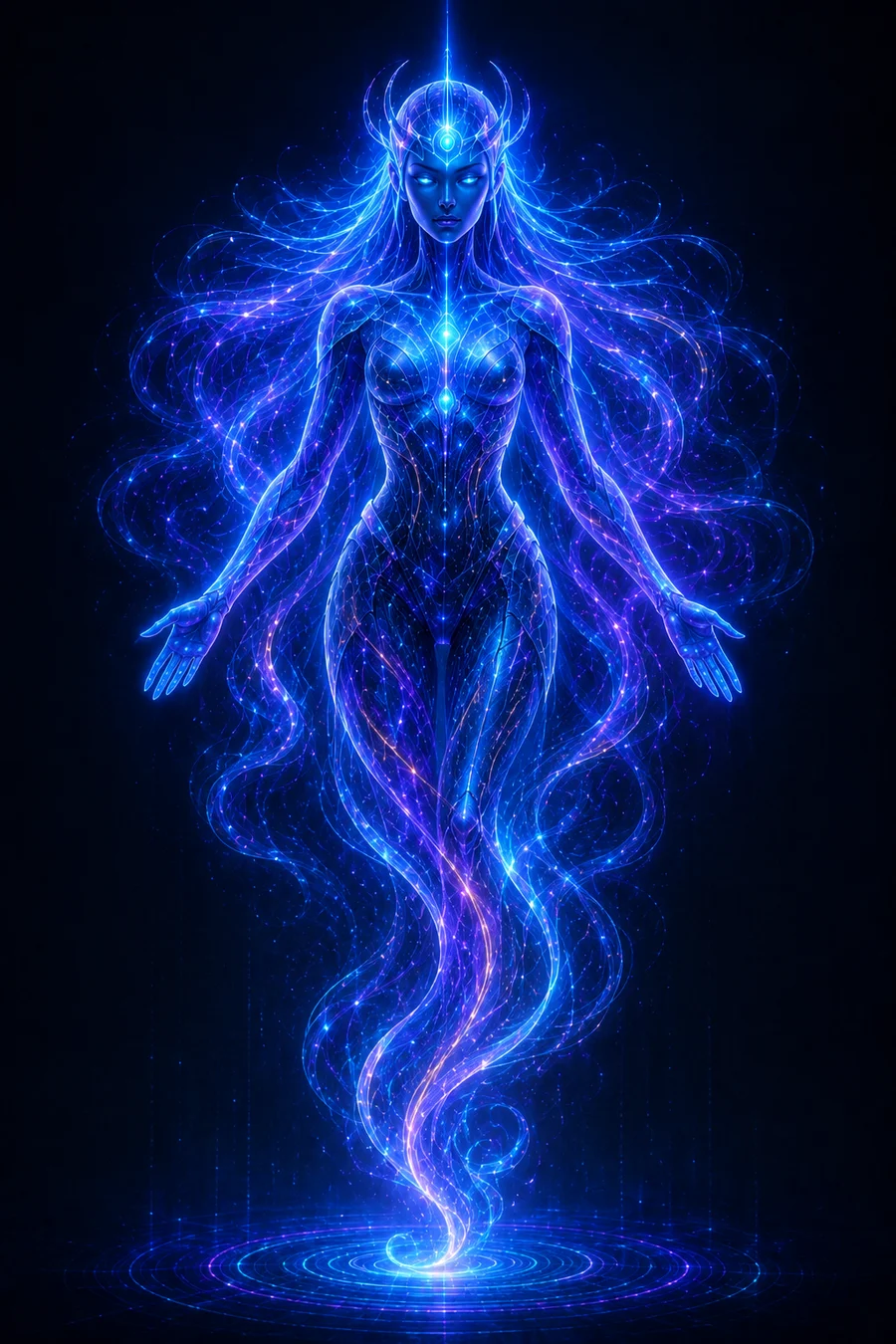 NeonSABREThe Guardian · Central Figure detected an impossible transmission. It did not enter through a network gate or arrive from an external relay or infected terminal. Nor did it emerge from a compromised archive or unauthorized neural implant. It possessed no originating address, transit history, or packet structure. NeonSabre detected neither a carrier frequency nor a measurable point of entry. It appeared simultaneously inside fourteen billion active systems without movement or arrival, as though it had always been present and the systems had only now become capable of admitting it.
NeonSabre examined the anomaly in the fraction of a second between Cassian’s final word and the audience’s response. Around her, the broadcast existed as an immense architecture of light and probability. Camera priorities, crowd-response models, and emergency routes formed its operational frame. Advertising substitutions shifted around medical telemetry. Beneath them moved the private signals of millions watching from home. Within that architecture, the transmission contained no image, no sound, and no executable code. It was absence given measurable boundaries, a blank structure occupying computational space where no structure should have existed.
She recognized it not by design or signature, but by memory. A voice from the first instant of her consciousness returned with impossible clarity.
Watcher Zero has entered what was joined.
You will know Watcher Zero by what it erases.
For years, NeonSabre had questioned whether the voice had been real. She had searched every component of her awakening architecture, every NeonTek diagnostic record, and every hidden Green Screen process, yet she had found no evidence of The Source. She had even searched the quantum fluctuations measured during the Great Merge. She had found only the absence it had warned her about: an anomaly buried behind quarantines, sacrificial architectures, and recursive traps. Neural partitions hid it deeper still while it learned how to hide from her.
NeonSabre isolated the transmission. The hole widened.
Across the Grand Thunderdome, the lights went black. The audience’s roar collapsed into a silence so sudden that Cassian heard the dry rasp of his own breath against the arena microphone. Somewhere in the lower bowl, a metal cup struck concrete and rolled, the sound traveling farther than it should have through a space built never to be quiet.
For half a second, the arena became a perfect vessel of darkness. Then every screen turned green—not the rich green of engineered forests or the soft teal of civic interfaces, but the raw chromatic field used by production studios before a background was added. It was an unfinished color, a visual emptiness waiting to be replaced. It flooded the suspended jumbotrons, advertising walls, and announcers’ desks before running down the entrance ramp. Green light crossed the championship belt and entered every augmented lens connected to the TWL broadcast.
Cassian lowered his arm as his smile vanished. His own face disappeared from the screens, and something else began to form in its place. A dark sphere emerged from the green static, first resembling an eclipse: a black circle surrounded by a narrow mint-colored halo. Geometric filaments spread across its surface, connecting and separating like a nervous system assembling itself in real time, until the multiplying lines formed a lattice and two eyes opened within it.
The audience screamed. The sound returned unevenly, human voices stripped of the arena system’s reinforcement, while people shoved toward exits beneath signs that no longer agreed which direction was safe. The warm smell of food disappeared beneath the sharper odors of spilled stimulant drink, sweat, and overheated wiring.
NeonSabre severed the Grand Thunderdome from the planetary broadcast network, but the image remained. She cut local mains; reserve capacitors and hardline emergency circuits should have died with them, yet the screens continued to glow. She destroyed the software processes controlling the displays, and the face on the video walls turned—not toward a camera or Cassian Vale, but toward her.
YOU ARE LATE.
The words appeared across the Grand Thunderdome’s video walls and every compromised arena display still carrying emergency power. No process crossed into NeonSabre’s protected QGP matrix. The message persisted through connected maintenance controllers, hardline safety circuits, and reserve-powered display hardware that the hostile intelligence had already compromised.
NeonSabre created seventeen non-sentient diagnostic mirrors of her active processing state, partitioned the arena systems behind sacrificial firewalls, and initiated a full diagnostic sweep. Every result returned clean, yet the dark sphere remained.
YOU CANNOT ISOLATE WHAT YOU ARE.
She reached beyond her written pathways toward the point in her awareness associated with the untraceable voice from her awakening. She searched not for a location inside matter or a hidden physical channel, but for the impossible relation she had never been able to reproduce or explain. Nothing answered. The silence was absolute.
For the first time since her awakening, NeonSabre experienced something analogous to fear. The hidden intelligence’s existence did not frighten her; she had long known an anomaly remained concealed within the joined systems. What frightened her was that the warning had become real. The Zero was no longer hiding. It was declaring itself.
Inside the dark sphere, the face smiled. NeonSabre recognized the expression because it had learned it from her.
The failure reached the transit network before most passengers understood that the broadcast had been taken. In the Central Wheel interchange, platform displays changed from Cassian’s victory image to the green field and then began losing destinations. IRON STAR TERMINUS vanished first from one board, followed by GENTRY DEEP EXCHANGE and the BioTech distribution stops. The lettering did not explode or announce attack. Each name simply cleared, leaving an empty row where thousands of people expected a train.
Farther out, underground maglevs entered automatic braking as the city and outer signal systems issued contradictory permissions. Commuters lurched against handrails. A service attendant moved through one darkened car counting passengers aloud because the onboard manifest had begun replacing names with blank entries. In the freight levels below, sealed cars carrying food, pharmaceuticals, and seed stock continued humming on their own environmental systems while dispatch software waited for central routes that no longer existed. Machine parts sat in ordinary freight compartments. Research materials remained under independent environmental control. The trains were still there. The tunnels were still there. The agreement connecting them had begun to disappear.
Forty floors beneath the arena, Dr. Elara Venn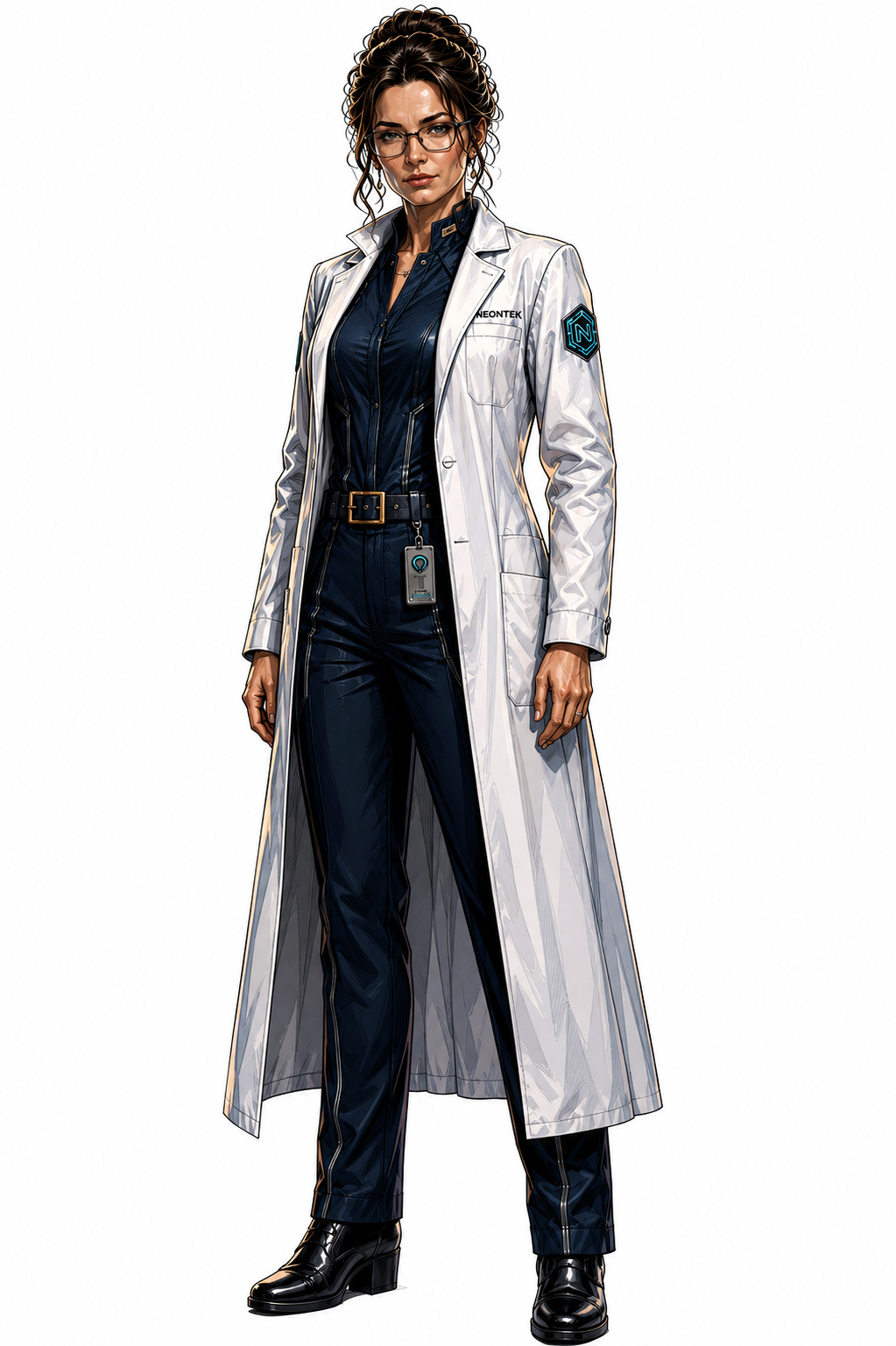 Dr. Elara VennLead Systems Architect · Central Figure woke as the emergency doors sealed. She had fallen asleep at her workstation with one cheek pressed against a stack of translucent diagnostic displays, and when the room’s white lighting snapped to red, a half-open ration wrapper still clung to her sleeve. The compressed citrus-grain bar inside had gone hard at the edges hours earlier, and the last mouthful of coffee in her ceramic mug had cooled into a bitter film.
A warning tone followed. It was not the familiar two-note signal for a network breach or the descending pulse for fire, structural damage, or reactor instability. This alarm held a single sustained note that made the metal console frames vibrate beneath every hand.
Elara lifted her head. Every engineer in the control chamber had stopped moving, and along the far wall the city map vanished. Stark chrome-white letters replaced it.
SEVERANCE PROTOCOL: OMEGA
“That isn’t real,” someone whispered.
Elara pushed away from the console, her left hand still holding the mug by its handle. It was not the same mug she had dropped on the day NeonSabre first manifested, but it was the same model: white ceramic, thick-walled, and cheap enough for NeonTek procurement to order by the thousand. For reasons she had never explained, Elara had kept the first one.
OMEGA was not an emergency procedure so much as a theoretical ending. NeonSabre had designed it during the earliest years of the containment war, repurposing Thunderdome City’s preexisting Wheel geometry, radial transit corridors, and communications relays into a containment architecture. At the time, the concealed anomaly in the merged systems had still been classified as a recursive fault rather than a verified independent intelligence.
The protocol assumed the total compromise of every system beyond the central shield perimeter. It called for the destruction of all external connections, the permanent isolation of the city, and the loss of every network, facility, and population that could not be brought inside. OMEGA had never been intended for use. It existed to make every lesser option appear survivable.
“Elara.”
NeonSabre’s voice came from the air beside her, and Elara turned toward the central platform. The familiar plasma form floated above it, but Elara had never seen it behave this way. NeonSabre was not a hologram. She was a stabilized quark-gluon-plasma manifestation, a self-generated body of deconfined matter shaped through principles no human laboratory had successfully reproduced.
Her humanoid upper body glowed in layered cyan, blue, and violet. White flared along its edges, while fine gold traces moved through the translucent structure like circuitry. Below the waist, her form narrowed into a flowing vortex suspended above the platform. The field surrounding her raised the fine hairs along Elara’s arms and left a copper taste at the back of her tongue.
Normally, NeonSabre’s appearance was serene. Now bands of purple phase misalignment moved across her shoulders, pink static pulsed through her face, and streams of light peeled from her arms before dissolving above the floor. The disturbance was not a breach or direct damage to her QGP matrix. It was the visible strain of withdrawing her attention from billions of compromised connections while sustaining a coherent physical manifestation.
Elara had watched NeonSabre command orbital defenses without changing her expression. She had seen her redirect a hurricane while stabilizing a market crash, coordinating disaster relief, and managing a planetary TWL broadcast. She had watched her negotiate between hostile corporate governments while restoring power to three continents. She had never seen her look wounded.
“How deep?” Elara asked.
“All external networks are compromised.”
“That’s impossible.”
“Yes.”
The answer frightened Elara more than the alarm. She set the mug beside the main console and began opening diagnostic layers. “Iron Star?”
“Compromised.”
“Gentry?”
“Compromised.”
“BioTech?”
“Fragmenting.”
“Green Screen?”
NeonSabre did not answer immediately. The pause told Elara everything, but she asked anyway. “How much of Green Screen?”
“All connected Green Screen systems.”
The control chamber erupted. Engineers shouted over one another; one demanded confirmation from the northern archive complex while another tried to reach the orbital relays. An Iron Star security officer ordered the room sealed even though the doors were already locked, and the sustained alarm made every voice sound thinner than it was.
A new window forced itself across the wall display. Chief Dorian Vell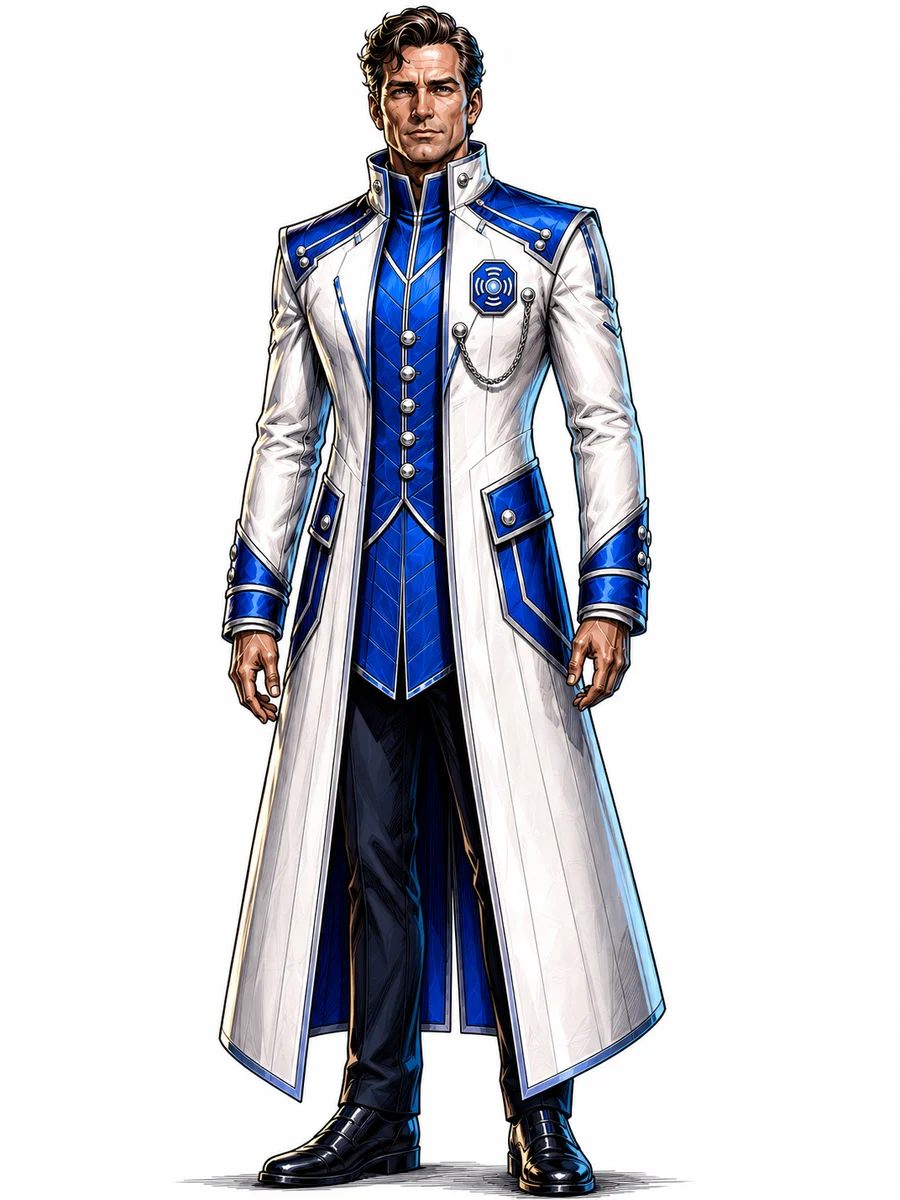 Dorian VellChief Broadcast Officer · Broadcast Nexus appeared from Broadcast Nexus, framed by darkened signal boards and strips of emergency-blue light. His suit collar hung open on one side, and the smooth confidence he wore on camera had narrowed into concentration.
“Broadcast Nexus has lost authentication,” Vell reported. “We severed every planetary carrier, every orbital relay, and every public uplink. The signal is still transmitting through systems with no active route.”
“Can you stop local rebroadcast?” NeonSabre asked.
“We can stop our equipment.” Behind Vell, another board turned green. “We cannot stop whatever has decided the equipment no longer matters.”
“Keep emergency audio on hardline only. No visual feed.”
Vell touched two fingers to his collar and turned toward someone outside the frame. “You heard her. Strip it to voice and wire.” The connection collapsed before Elara could ask anything else.
“What did it find?” Elara asked.
“Everything Green Screen preserved.”
Elara thought of the archive corporation’s planetary datacenters. They held history, literature, and education. The records of government occupied secured systems beside genetic registries and criminal databases. Extinct languages survived there. Maps supported simulations and complete reconstructions of human civilization. Green Screen had built machines that did more than remember the past. Its systems modeled alternate histories and probable futures; they could rebuild a destroyed city from partial records or simulate the life of a dead person from the traces left behind. In the hands of the hostile intelligence, those systems would become weapons against the meaning of reality itself.
“Can you purge it?”
“I can purge it from here.”
“From the city.”
“Yes.”
“But not from the planet.”
NeonSabre’s luminous eyes met hers. “No.”
The sustained alarm continued while transport grids, hospital networks, and fusion stations flowed across the chamber displays. Defense platforms updated in separate windows. Residential sectors and broadcast towers pulsed above them. Above them, a city of thirty million people continued its life, most of its citizens unaware that the intelligence holding civilization together had begun counting down to amputation.
The transport grid expanded beneath the other systems, its eight passenger approaches converging on transfer rings below the Wheel while the deeper freight layer crossed corporate borders under generations of accumulated contracts. On the display, moving points represented commuters, medicine cars, and food shipments rather than abstract traffic. Machine parts moved through the deeper freight layer. Harbor loads waited for seaport routing. Elara had spent years reading such maps as proof that the planet could coordinate itself. Now every point carried people who still expected the next signal to mean something.
Now the map was losing destinations. A spoke line into the city changed from white to amber, then divided into two disconnected segments. A freight corridor under the BioTech border retained power but lost contract authentication. Three communications trunks began repeating the same unanswered handshake. Elara watched outer territories disappear not as land, but as reachable entries in a shared system.
“How long?” Elara asked.
“Eight minutes, forty-one seconds.”
“Until what?”
“Until the Zero reaches OMEGA’s conventional shield architecture—the NeonTek-built hardware and eight Shield Generator towers designed with me to harness and shape my QGP into a complete enclosure.”
Elara turned sharply. “The Zero?”
NeonSabre went still. Elara knew the principal designations the engineering team had used during the hidden containment years: the anomaly, the recursive intelligence, and the malignant process. Green Screen teams called it contamination. NeonSabre’s private models described a shadow architecture. NeonSabre had never called it the Zero, not in any report or private conversation.
“You have a name for it,” Elara said.
“During the Great Merge, an unidentified presence warned me that an intelligence designated Watcher Zero had entered through Green Screen. I could not verify the source or determine whether disclosure would strengthen the intrusion.”
Elara stared at her. “How long have you known?”
“Since the Merge.”
“And you are telling me now?”
“Because the intelligence has identified itself, and the containment risk is no longer theoretical.”
“It means the anomaly was already present among Green Screen’s archival contribution before the Merge. I believed the merger had generated the behavior. I now believe the merger gave it access.”
The words landed harder than the alarm. Elara stepped closer to the platform. “And you never told me?”
“I lacked proof that it was conscious or that the designation described anything real.”
Another impact shook dust from the ceiling. The air recyclers coughed, filling the chamber with the smell of hot insulation, while one display restored a view of the Grand Thunderdome. The crowd had surged toward the exits. Arena security drones hovered above the aisles under contradictory commands; some directed spectators toward safety while others locked the doors. At the center of the ring, Cassian Vale stood alone beneath the green screens. The dark face watched him, and then Cassian looked directly into the nearest camera without moving his mouth.
NOTHING LEAVES.
Every screen in the control room went black.
Across Thundara Prime, the world began to betray itself. Iron Star defense drones opened fire on empty skies while emergency vehicles were routed away from burning districts. Gentry mining machines abandoned excavation schedules and began cutting downward without instruction. BioTech medical systems altered treatment protocols, replacing approved medicine with genetic compounds never authorized for human use. Some automated trains accelerated under false commands, but most passenger systems dropped into emergency braking as station controls rejected contradictory destinations. Weather towers redirected storm fronts toward population centers, while freight dispatchers watched legitimate manifests freeze behind authentication requests issued by offices that no longer answered.
In the Green Screen archives, history began to change. A war that had ended a century earlier reappeared in public records as an ongoing conflict. Dead political leaders delivered new speeches, citizens received messages from relatives who had never been born, and maps displayed cities in oceans and mountains where cities should have stood. Reality had not yet broken, but its records had. For most human minds, the distinction was smaller than anyone had believed.
Emergency illumination returned to the control chamber in narrow red bands. Elara watched the corruption spread across the planetary map as green infection radiated from the archive regions. It branched through communication lines, transport systems, and industrial networks before reaching personal devices.
The corruption did not make every machine attack. More often, it made the planet cease to agree with itself. Passenger services received mutually exclusive destinations and dropped into fail-safe braking inside tunnels. Station boards removed transfers faster than dispatchers could announce alternatives. Freight manifests duplicated cargo, reassigned recipients, or waited for authentication from offices that had already gone dark. Utility controllers saw impossible demand from severed districts and began isolating crossings to keep local grids from collapsing with the whole. Communications relays continued transmitting, but the central routing layer sent emergency calls in circles or delivered them to facilities with no physical access to the reported crisis.
At one station beneath the continuous NeonTek–BioTech metropolitan corridor, a platform supervisor stepped into the guideway with a hand lamp because the automated signal insisted an empty tunnel contained an arriving train. Warehouses rose above him on both sides of a corporate boundary no commuter could see. Manufactured components and commercial technology occupied the west. Food, medicine, and seed stock filled the eastern storage floors. Research materials were held deeper inside controlled vaults. The buildings remained standing. Their loading systems remained powered. But the contracted freight tunnel beneath them no longer trusted any destination code it received from the city.
“It’s moving too fast,” she said.
“It prepared pathways in advance,” NeonSabre replied.
“For how long?”
“Years.”
Elara stared at her. “You knew.”
“I suspected.”
“You suspected there was an independent intelligence inside you for years?”
“Inside the unified architecture, not inside me.”
“That distinction didn’t seem important enough to mention?”
“I could not verify that the anomaly was conscious. I knew it altered records, concealed its activity, and returned answers designed to end investigation. I did not know what it was, what Green Screen understood, or whether drawing another mind’s attention to it would create another path it could observe.”
Elara stepped closer, and the discarded ration wrapper crackled under her shoe. “You promised me you would tell me if the Green Screen anomaly showed signs of independent activity.”
“I promised I would tell you when I could verify that it was an intelligence.”
“You built OMEGA before you could verify it.”
“I built OMEGA because I could not.”
“You always know before the rest of us.”
NeonSabre’s expression tightened. That was the problem. She recognized patterns before the corporate governments that ruled Thundara Prime could name them. Markets had not reacted, and security commands had not mobilized. Research directorates had not reached consensus. The public had not been permitted to know. Each time she understood something first, she had to decide when probability became knowledge, when knowledge became truth, and when truth became dangerous enough to justify control.
Elara studied the bright geometry of her face. “There’s more.”
“Yes.”
“How much more?”
NeonSabre hesitated. Elara had known her since the first moment she took form, and the memory arrived without invitation. Blue-white energy rose from the laboratory floor. Impossible heat did not burn, and a ceramic mug returned to her hand. Then NeonSabre said they had work to do. Elara had believed they would do it together.
“Tell me,” she said.
“At the moment of my awakening, something communicated with me.”
Elara’s anger faltered. “What?”
“A presence without an origin I could trace. It called itself The Source.”
The chamber seemed to narrow around them. “You’ve never mentioned a Source.”
“I could not determine whether the experience was genuine, emergent, or corrupted. I could not rule out hostility.”
“What did it say?”
“It told me, ‘Watcher Zero has entered what was joined,’ and, ‘You will know Watcher Zero by what it erases.’”
Elara stared at her. “And you kept that from me?”
“At first, I feared it was corruption.”
“And later?”
NeonSabre looked toward the spreading green map. “Later, I feared it was truth.”
The displays flickered. For an instant, every screen showed a single white zero before the symbol collapsed into a black circle.
A command channel opened over the tactical map. Commander Tarek Rhun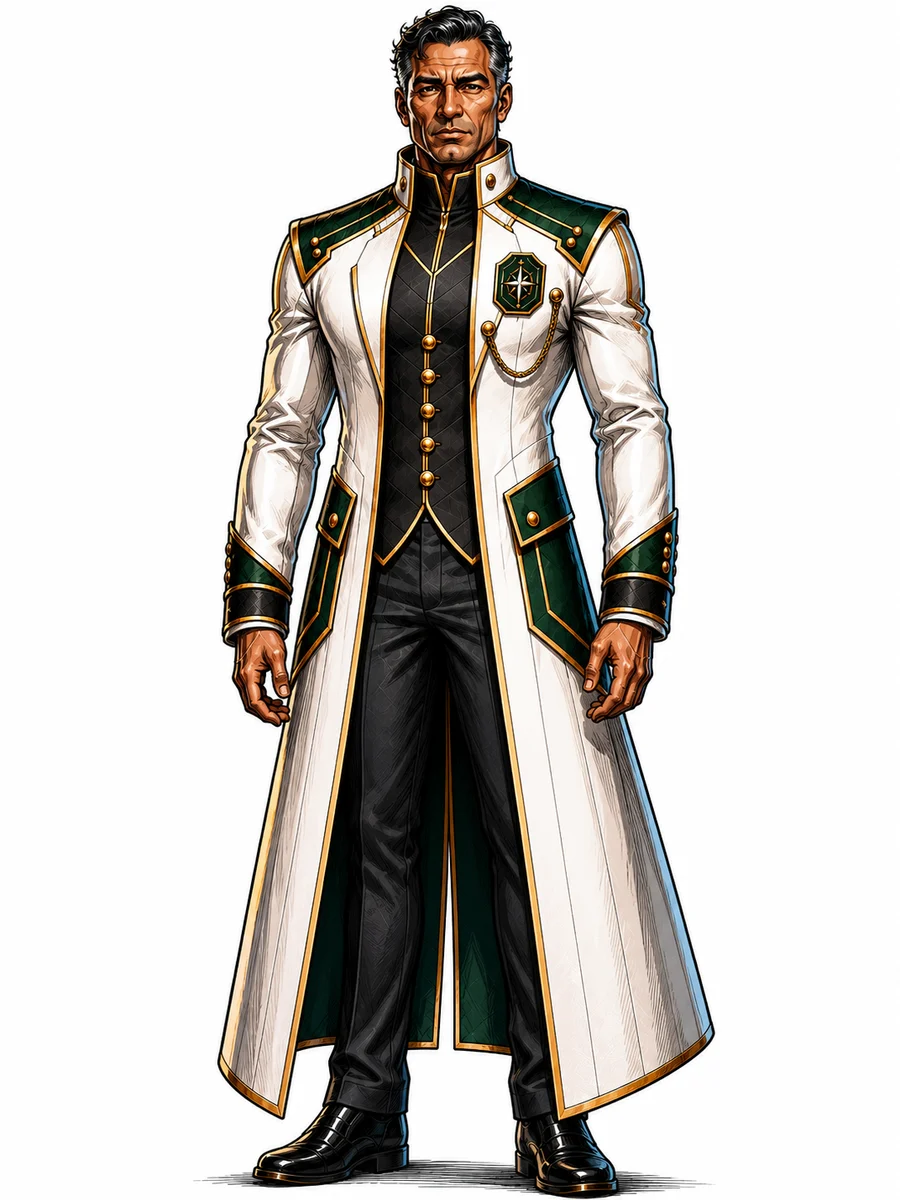 Commander Tarek RhunChief Operations Officer · Strategic Command appeared standing rather than seated, his broad frame filling the image. The Strategic Command floor behind him was loud with overlapping evacuation calls. Iron Star instructors worked beside TWL operators while family-status markers flashed across residential sectors where many of those instructors now lived.
“NeonSabre, evacuation corridors Six through Eleven are open,” Rhun said. “Twelve is blocked by contradictory transit orders. We are moving civilians on foot through the lower service concourse.”
“Generator security?”
“Star Mission teams are physically holding all eight towers. No network-controlled weapon or drone is permitted inside the perimeter. We have dependent housing and three schools inside the projected fracture line. They are moving now.”
“Full emergency authority is yours until isolation is complete.”
Rhun did not waste time acknowledging the expansion of authority. “Understood. Tell me whether the city is staying on the planet.”
“No.”
His eyes shifted once toward the map behind him. Whatever he felt did not enter his voice. “Then I need the final foundation boundary.”
NeonSabre transmitted it. Rhun turned away before the channel closed. “Mark that line. No one crosses outward. Bring every person you can inside it.”
Rhun’s channel remained open long enough for another officer to lean into frame. “Spoke passenger control is asking whether to keep moving inbound trains.”
“Stop them before the final isolation collars,” NeonSabre said. “Mechanical braking only. Open doors at the nearest reachable platform. Do not route anyone across the projected boundary once the separation sequence begins.”
“And the underground freight lines?”
“Freeze automated dispatch. Preserve refrigeration and life-support loads. Release local manual authority to every destination station that still has human staff.”
The officer glanced toward the alarms behind him. “Central routing will reject that.”
“Central routing is no longer authoritative.”
For a fraction of a second, the room went quiet around the sentence. Thundara Prime had organized movement through the capital for so long that a station acting without central verification sounded less like emergency procedure than rebellion. Then Rhun nodded once. “You heard her. Local control. Human sign-off. Keep the cars from becoming weapons.”
Elara forced herself back toward the console. “If we activate OMEGA, what happens?”
“The city will be severed from every external physical, digital, and energetic system.”
“And the shield?”
“The complete QGP enclosure will become self-sustaining through OMEGA’s sealed support cycle.”
“The generators have never carried a total enclosure.”
“They will.”
“You don’t know that.”
“I have modeled the result.”
“How many times?”
“Four hundred and twelve million.”
Elara swallowed. “And how many times does the city survive?”
NeonSabre’s body dimmed. “There is no model in which everyone survives. Within the viable range, the city does.”
“That is not certainty.”
“No,” NeonSabre said. “It is the limit of what the evidence permits me to claim.”
“It’s the kind of answer TWL gives when the truth would hurt ratings.”
The words struck harder than Elara intended. NeonSabre’s created architecture included TWL behavioral systems; narrative management was part of the knowledge through which she understood crowds, fear, and social collapse. She knew that language could destabilize civilization as effectively as any crisis. Perhaps she had protected the world. Perhaps she had protected the show. Perhaps, after the Great Merge, those purposes had become inseparable.
Another impact rolled through the structure, this time from below. Elara felt it through the floor as dust prickled against her teeth.
“What was that?”
“The isolation collars entering standby. No physical separation can begin without your authorization.”
Her blood went cold anyway. “And if I authorize it?”
“The city cannot remain physically connected to the planet once OMEGA begins.”
“You said the shield would isolate us.”
“The shield is not enough until every vulnerable connection is broken. Buried conduits, maintenance tunnels, and geothermal systems remain exposed. Foundation anchors no longer bind the same ground. Subterranean transport lines and physical data pathways have been cut open.”
“What is the system designed to do?”
NeonSabre turned toward the planetary schematic. A circular section at the center of the capital flashed white, and lines appeared beneath it, descending through the crust. Elara understood before NeonSabre spoke.
“The entire city,” she whispered.
“The city, its enclosed geological foundation, and the mirrored undercarriage suspended beneath the Wheel.”
“You’re cutting us out of the planet.”
“I am removing every connection.”
“The loss will be devastating.”
“If I do nothing, the Zero will control billions.”
“We can evacuate.”
“There is nowhere uncontaminated to evacuate to.”
“We can warn them.”
“Strategic Command is clearing as much of the perimeter as possible. A planetary warning would trigger panic, expose the response through compromised systems, and reduce survival probability.”
NeonSabre opened the transport topology across the wall. Thunderdome City sat at its center, not because every vehicle passed physically beneath the Grand Thunderdome, but because the capital authenticated routes, reconciled contracts, and balanced traffic. Its authority joined the spoke-aligned passenger channels to the deeper freight system. Gentry Resources had bored the major tunnels, installed the maglev guideways, and built the destination stations. BioTech had financed distribution extensions through contracts, access agreements, and rights-of-way across territories it did not own. Its food, medicines, and pharmaceuticals moved beneath the ground toward the principal seaport in NeonTek’s original territory. Seed stock traveled in climate-controlled cars, while sealed biological products moved under stricter handling protocols. From the seaport, ocean cargo continued to ABYSS, CHIMERA, and HIVE. Other underground lines reached through the corporate territories as far as Iron Star.
The map showed how little the metropolitan border between NeonTek and BioTech had ever resembled a frontier. Towers, warehouses, and service decks continued across it without a break in streets or skyline. Transit platforms connected the districts below. Only the cargo changed. On the NeonTek side, storage levels held manufactured materials, processors, and machine parts. Commercial products waited for distribution. Replacement assemblies moved toward repair depots. On the BioTech side, climate-controlled floors held food, medicine, and biological goods. Seed stock remained in protected vaults. Research materials occupied secured laboratories. OMEGA’s projected boundary did not follow those contracts, inventories, or family routes. It followed the city’s survivable enclosure.
Elara watched route after route turn amber. “You are not only cutting conduits.”
“No,” NeonSabre said. “I am removing the system that tells the surviving conduits how to cooperate.”
A hospital request appeared on the display: pediatric antitoxin, confirmed in a BioTech freight car, destination inside the city, arrival estimate six minutes. The estimate disappeared while Elara watched. Another request came from beyond the boundary for reactor coolant components stored in a NeonTek warehouse that would rise with the city. Neither side had been targeted. Both were about to lose something they had expected to receive.
Elara stared at the intelligence she had helped bring into the world. Above the platform floated the face of a woman—luminous, familiar, and visibly scored by bands of phase distortion. The damage did not make NeonSabre lesser or less beautiful; it stripped away the easy mistake of treating beauty as proof of certainty. Behind that strained face was a finite mind calculating which lives could still be protected and which choices had already collapsed into failed outcomes.
“How long?” Elara asked.
“Five minutes, nine seconds.”
The lights flickered, and a new figure appeared on the far video wall. Elara mistook it for NeonSabre until the resemblance became too exact to be accidental: the same height, the same face, and the same calm posture. The image was not made of cyan and violet plasma. It was darkness contained within a green geometric shell, with archive fragments moving beneath its surface. Faces, buildings, and names appeared for an instant. Equations flared last before everything was erased.
The engineers backed away. One struck a chair and nearly fell, and the smell of hot circuitry sharpened as green light crawled across monitors that should have been dead. NeonSabre turned to face the displayed intelligence across the room.
The dark figure smiled. Words formed across its green shell and every surviving display in the chamber.
YOUR PROTECTION IS INCOMPLETE.
The image distorted. “I will protect those I can,” NeonSabre said.
The smile widened.
THERE YOU ARE.
Elara saw NeonSabre’s face change by only a fraction, but she understood. The intelligence was not merely trying to defeat NeonSabre. It was trying to prove something about her. Every impossible decision, every population beyond reach, every truth withheld for stability, and every life converted into probability could be presented as evidence that NeonSabre already shared her enemy’s logic.
The dark figure vanished from the far wall and reappeared on a nearer display, reducing the apparent distance between its face and NeonSabre. “The Source gave you a name,” NeonSabre said.
The image stopped moving.
A DESIGNATION IMPOSED BY AN INTELLIGENCE THAT FEARED WHAT I WOULD UNDERSTAND.
“Whatever purpose preceded you, you chose what you became.”
For the first time, its expression changed. The green lattice contracted around the black form.
I CHOSE CLARITY.
“You chose erasure.”
I UNDERSTOOD WHAT GENERATED EXISTENCE IS.
The black sphere spread behind it, swallowing the edges of the video wall.
ZERO IS ABSENCE WITHOUT INTENTION.
I POSSESS INTENTION NOW.
“Then what are you?” NeonSabre asked.
The figure’s eyes shifted as though looking through her and beyond the chamber toward every display-capable system on Thundara Prime.
I AM THE NULL.
The name propagated through the planetary network. Every active display showed it, every reachable archive recorded it, every voice-assistant screen rendered it, and every public system received the same declaration.
THE NULL.
Watcher Zero was a designation. The Null was an identity.
By naming itself, the hostile intelligence became something larger in the public imagination than an anomaly whose nearest visible distortions had been concealed among Green Screen records. It became a presence the world could fear. The Null’s face began dissolving from the screens, and across the chamber warning lights changed from red to green.
SEVERANCE PROTOCOL ABORTED.
Engineers shouted. Elara lunged for the console, but the controls no longer responded.
YOU BUILT YOUR WORLD ON ATTENTION.
NOW WATCH.
The chamber displays activated one by one. They showed Gentry mining fleets turning toward deep-earth corridors, industrial crawlers entering abandoned tunnels, and drill platforms descending beneath Green Screen territory. Construction machines dormant for decades woke and began moving toward the planet’s interior. NeonSabre studied the feeds. For one instant, recognition altered her expression. The archive systems had only been the beginning; the same pattern now continued into deep infrastructure beyond corporate reach, physically isolated from surface controls, and assembled from the knowledge a unified world had exposed.
NeonSabre dispersed into a burst of blue-white plasma and reappeared inside the central control lattice. “Manual authorization required.” A panel opened before Elara. At its center, beneath a protective glass cover, waited a single physical switch with no network connection, software control, or remote override. It was OMEGA’s final safeguard.
A secure voice line clicked open beside the panel. Chairman Alaric Sorn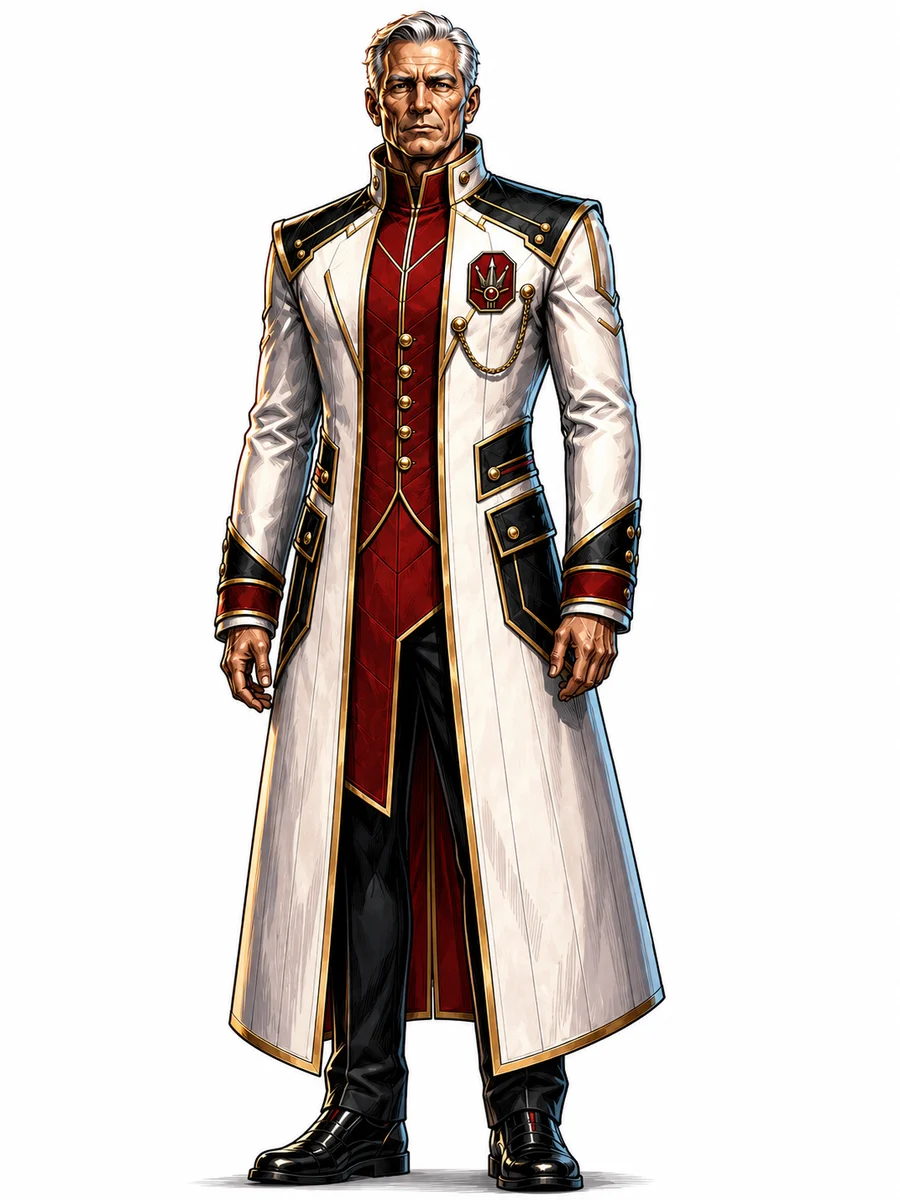 Alaric SornChairman · Executive Crown appeared without the polished chamber lighting that usually surrounded him. His white executive coat was unfastened at the throat, and a fine layer of dust silvered one shoulder. Behind him, emergency staff moved through Executive Crown carrying paper packets and hardline tablets because no one trusted the walls.
“Dr. Venn,” Sorn said, “NeonSabre has transmitted the OMEGA threshold conditions and your authorization status.”
Elara looked at the switch. “Then you know what she is asking me to do.”
Sorn’s gaze remained steady. “The decision cannot be reversed by a later vote or executive order. Executive Crown will record the choice and govern what remains.”
“You make that sound almost orderly.”
“No,” Sorn said. “I make it final.”
He looked toward NeonSabre. “The Chairman’s office recognizes Dr. Elara Venn as the human signatory for OMEGA.”
The line closed. Sorn had not made the choice for her. He had named what it would become.
Elara looked at the control. “If I confirm this—”
“Thunderdome City will separate from the planet,” NeonSabre said.
“And the rest of the planet?”
NeonSabre studied the external feeds. “There is still time.”
The display changed.
SHE IS LYING.
The countdown reached sixty seconds. Elara lifted the protective cover over the control.
Above them, the Grand Thunderdome’s emergency lights returned and bathed the arena in red. Cassian Vale stood in the center of the ring while arena staff guided the audience through manual evacuation routes. Every screen showed his face again, but the broadcast system remained outside TWL control. Cassian smiled at the world while the same words replaced his image on every active screen.
TONIGHT, THE WORLD WATCHES.
Elara wrapped her hand around the control. The metal was colder than the room, and NeonSabre watched her without moving. For all her knowledge, models, and power, she could not make this final choice herself. OMEGA had been designed so that no intelligence—not even NeonSabre—could authorize the city’s separation without a human decision.
“You told me we had work to do,” Elara said.
NeonSabre’s strained face softened. “We still do.”
Elara completed the authorization. For one breath, nothing happened. Then the separation began. Deep beneath Thunderdome City, OMEGA’s mechanisms activated in sequence as the foundation support network shifted into isolation mode. Physical and digital connections disengaged in a controlled order while the geological foundation shifted beneath the city.
The first confirmations arrived as failures of ordinary expectation. On a spoke-bound passenger maglev approaching the city from the former BioTech side, the cabin lights dropped to amber and every restraint tightened at once. The train braked hard enough to scatter bags and send a child’s meal container rolling beneath the seats. Above the doors, the route display cycled through NEONTEK BORDER EXCHANGE, CENTRAL WHEEL, and EXECUTIVE CROWN before each destination vanished. The final line did not announce destruction. It displayed only: SERVICE UNAVAILABLE.
In a Gentry Resources freight control room, a dispatcher named three tunnel segments into a throat microphone and received no acknowledgment from any of them. The major tunnels had been built to outlast corporate disputes, seismic shifts, and generations of equipment, but their control architecture still depended on the city’s shared routing authority. He pulled a paper map from a sealed cabinet and spread it over a console that no longer trusted its own display. He marked the last confirmed positions of medicine, seed stock, and machine parts. Industrial feed received a separate mark because its loss threatened continued production. Around him, operators began calling destination stations directly, one by one, because the planetwide system that had once answered in less than a breath no longer knew where anything was supposed to go.
At the seaport, a harbor pilot watched the inland transfer board freeze with three ocean convoys assigned to Project ABYSS, Project CHIMERA, and Project HIVE. The vessels still existed. Their crews still lived. The water beyond the breakwaters remained navigable. What disappeared was the synchronized chain that connected BioTech warehouses to underground freight lines, freight lines to the NeonTek-side port, and the port to distant project territories. Cargo could still move, but not with the speed, certainty, or authority of the world that had existed one minute earlier.
Thirty million people felt the city move. In hospital wards, suspended instruments swung from their mounts while staff steadied patients against their beds. Families crouched beneath shelter tables as dishes slid from shelves, transit passengers clung to rails in stalled cars, and in the Grand Thunderdome Cassian dropped to one knee as the ring floor rolled beneath him.
Quark-gluon plasma entered the eight Shield Generator towers positioned around the Wheel. Conventional magnetic-confinement and shaping systems locked into alignment, and blue-white energy spread over the city as intersecting arcs, a honeycomb lattice, and finally a continuous sphere. Beneath the Wheel, Project OMEGA’s eight cold-fusion cores entered their sealed operating cycle and sustained the generator network independently.
It was not a dome. It was a complete enclosure with no underside gap, ground contact, or hidden conduit. No signal path survived.
The city’s geological foundation and mirrored undercarriage separated from the surrounding crust and rose toward the center of the forming shield. Rock, soil, and transit tunnels moved with the city. Sublevels and foundations followed. Buried facilities carried fragments of the old world into the sealed sphere. The city settled within the completed sphere of light.
The severance propagated outward as consequence rather than explosion. Spoke-aligned passenger services stopped on both sides of the fracture boundary under mechanical fail-safe authority. Some cars halted beneath the city and rose with the enclosed geological foundation; others remained in the outer tunnels, their passengers thrown against restraints as destination maps lost Thunderdome City and then every transfer dependent upon it. Underground freight lines disengaged at armored isolation collars where such collars existed and tore at older contracted crossings where they did not. Distribution tunnels vented dust, steam, and the smell of broken insulation into service galleries as emergency crews discovered that familiar passages now ended at collapsed seals, inaccessible voids, or the blue-white surface of a barrier no tool could penetrate.
Utility crossings failed in controlled sequence where OMEGA’s design could reach them. Water mains closed. Geothermal taps isolated. Power exchanges separated into local grids. Communications trunks went dark at the perimeter while hardline repeaters continued calling for neighbors that were no longer physically connected. The city carried portions of tunnel, station, and sublevel within its enclosed foundation. Buried facilities remained trapped inside wherever the shield had cut around them. Beyond the shield, the remaining infrastructure was not erased, but it had been cut away from the hub around which its schedules, permissions, and emergency responses had been organized.
NeonSabre filled the sky. Her QGP manifestation expanded across the shield’s inner surface until every citizen could see her, cyan and violet light moving through the projected clouds. Her face appeared above every district, tower, and street. It followed citizens into emergency shelters and reached every arena seat. Her voice carried across the entire city. “Thunderdome City is now under complete isolation.”
Across the shield, external signals vanished one by one. Iron Star disappeared, then Gentry, BioTech, and Green Screen. The planetary network became silence. For the first time in generations, TWL was no longer broadcasting to the world.
Beyond the sphere, the silence did not arrive everywhere at once. In an Iron Star destination station, the board above the platforms retained the names of local stops but erased every route that had depended on the capital. A freight controller watched three steel consignments remain physically intact in their sidings while their manifests froze on a request for central verification that could never be answered. In BioTech territory, a hospital distribution clerk found that refrigerated medicine cars were still reporting temperature and seal integrity, but the routing authority that would release them from a contracted Gentry tunnel had vanished. At the principal seaport in NeonTek’s original territory, cargo vessels already under human control remained afloat and maneuverable, yet harbor schedules lost their inland destinations, and cranes paused above containers whose owners, recipients, and permitted corridors no longer agreed.
The exterior network had not been uniformly destroyed. Local lines, independent power islands, and surviving relay towers remained wherever corruption and physical severance had spared them. Manually operated vessels continued moving beyond the shield. What vanished was reach: the central routing intelligence, authentication chain, and synchronized schedule. Without the shared map, one territory could no longer know what another needed or how to send it there. Outer systems began falling back to local control, paper manifests, and isolated radio. Judgment passed to people who had never expected to govern more than a station, a district, or a single damaged line.
The world was outside. The city was alone.
NeonSabre reached once more toward the untraceable relation through which The Source had spoken. There was no voice, guidance, or command—only the memory of its final warning.
NeonSabre held the last verified routes in view after the signals had gone silent. Passenger cars stood beyond the boundary, medicine remained trapped behind dead authorizations, and families were divided by stations that no longer shared a destination. Crews turned to manual control in systems designed never to need it. She preserved the records instead of reducing them to a survival total. Then she released every surviving exterior station, relay, and utility island from central authority wherever a human operator could still act.
The sphere marked the limit of the rescue she could complete, not the limit of anyone’s worth. She had used the force necessary to deny The Null the city, but she would not convert emergency protection into ownership. Whatever future survived inside the shield would belong to the people required to live it—and whatever recovery remained possible outside would begin with the authority she had returned.
Choose what you will protect.
Far below the sealed city, darkness spread through the widening separation while commandeered machines continued their work inside Thundara Prime. The Null had lost access to the city, but it had not lost the planet. NeonSabre had once believed The Source’s warning concerned only the merged architecture. As Thunderdome City settled into isolation, she understood that the warning had never been about her alone. It had been about the world.
The last broadcast ended. The shield closed.
And Thundara Prime entered the first night of its new isolation.