Thundara Prime
The Last Marshal
The signal from Iron Star territory repeated every forty-seven seconds. It carried no voice, authorization code, or corporate signature—only a sequence of evacuation coordinates transmitted through a civil-defense frequency that official records said had been decommissioned one hundred and eighteen years earlier. Each route began at a populated settlement’s surviving destination station, rail yard, or civil-defense assembly point, then followed whatever rail, tunnel, and foot corridors remained open beyond the advancing reach of The Null.
Dr. Elara Venn Dr. Elara VennLead Systems Architect · Central Figure stood beneath the central display in Strategic Command and watched the paths write themselves across the damaged planetary map. A city inset at the display’s edge preserved Thunderdome City’s exact Wheel: inner and outer rings joined by eight radial maglev spokes, all sealed inside OMEGA rather than opening through a gate. Before the separation, northern passenger maglevs and underground freight lines had met Iron Star’s Central Hub and spread toward Lake Sovereign, Meridian Wells, and Ironwatch Keep. Eastern branches continued through the Proving Grounds before dividing toward Ironstar Citadel and Ironworks Basin. Now seven Iron Star settlements appeared in sequence, representing nearly two hundred thousand people, and their routes avoided corrupted rail systems, sealed tunnel mouths, and flooded transit corridors. Compromised defense platforms narrowed the remaining options. Beyond them, growing bands of green interference radiated from Green Screen territory.
Elara had already watched the planetwide network fail during OMEGA; the display did not need to teach her that history again. Here the consequences were specific to Iron Star: passenger and freight routes that once converged on the Central Hub now split into local fragments, while shared utility corridors, communications trunks, and data-routing lines ceased to agree about which settlements remained reachable. Destination boards lost names, freight permissions contradicted one another, and each rerouted power load sent a low vibration through the tactical deck. The recycled air carried overheated insulation beneath the sharper scent of a dispatcher’s mushroom coffee gone cold beside a stack of route slates.
“They’re being guided,” Elara said.
NeonSabre NeonSABREThe Guardian · Central Figure floated beside the display, her Quark-Gluon Plasma form still dimmer than usual. Narrow bands of violet phase misalignment moved beneath the blue-white surface of her shoulders, evidence of continuing post-severance stabilization rather than damage inflicted by The Null. “Yes.”
Commander Tarek Rhun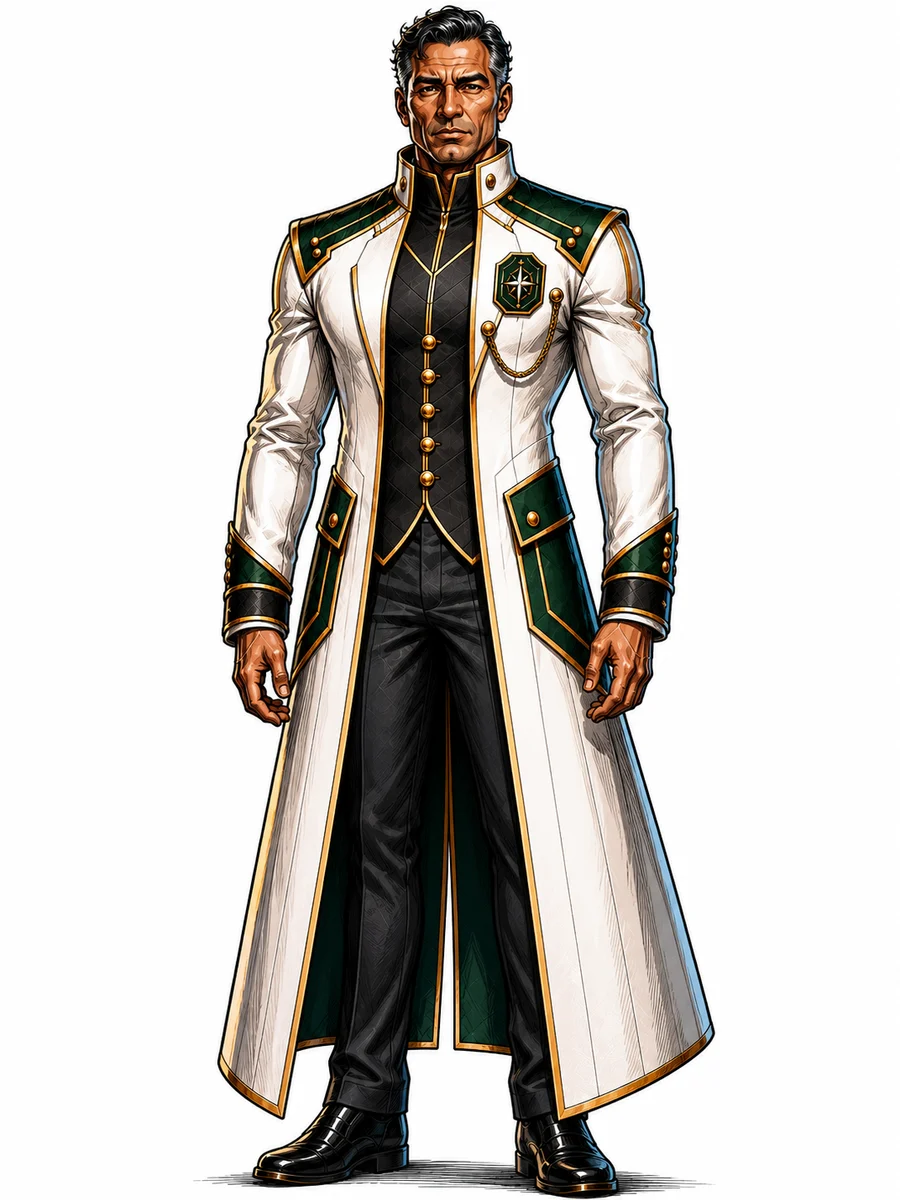 Commander Tarek RhunChief Operations Officer · Strategic Command had joined them from the tactical tier rather than calling a Full Byte session. He stood with his hands clasped behind his back, studying the packet structure while damaged Iron Star overlays blinked across the map. “That is not a battlefield frequency,” he said. “It belonged to the old continental civil-defense net—evacuation corridors, reservoir failures, and weather emergencies. Mass-casualty routing was its final purpose. The strongest surviving node is the Old Civil Defense Command Tower northeast of Meridian Wells, on the ridge between Meridian Wells and Ironwatch Keep. Its surface antennas were retired long ago, but the buried command infrastructure was designed to survive command collapse.”
Elara looked toward him. “Could Iron Star have brought it back online?”
“Not as a unified system.” Rhun expanded the surviving command nodes. Some covered single cities; others reached no farther than a fortified rail yard, destination station, or tunnel-control post. “The central hierarchy is gone. Local commanders are controlling whatever transmitters, vehicles, and weapons remain within reach. Some are protecting civilians. Others are protecting territory, supplies, or themselves.”
The evacuation signal passed through every surviving node without resistance. It used Iron Star hardware, but it did not obey Iron Star authority.
A visual fragment resolved at the center of the map. Marshal Mara Voss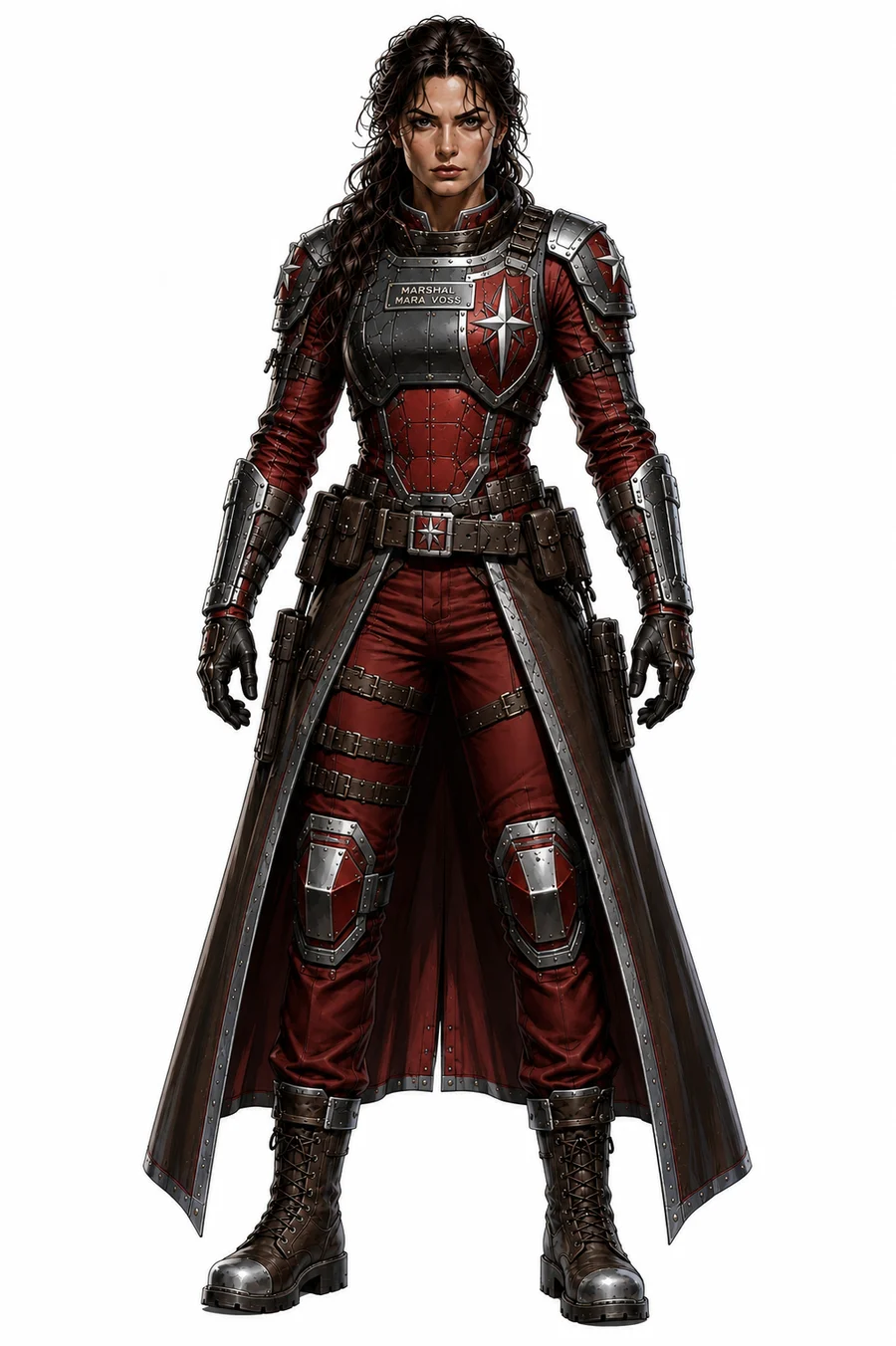 Marshal Mara VossLast Marshal · Iron Frontier stood beneath a damaged Iron Star shield emblem at a destination-station crossing, directing the last civilians from the exposed platforms into a sheltered tunnel approach while every tactical display around her ordered immediate withdrawal. Her iron-red field suit showed beneath a black riveted cuirass and silver-edged shoulder plates; the long split coat protecting her legs was ash-streaked, and the star-blade device on her chest had been scored nearly white by heat. One armored forearm hung useless at her side, but her steel-capped boots remained planted at the crossing.
Rhun lowered his chin as the image sharpened. “Mara Voss.”
“You know her?” Elara asked.
“I know the service record. Frontier marshal, civil-defense command, repeated insubordination when withdrawal orders abandoned populated zones.” The corner of Rhun’s mouth tightened without becoming a smile. “Iron Star kept promoting her because settlements survived when she ignored the wrong orders.”
“Civilians first,” Voss said through the damaged feed. Without looking away from the crossing, she pointed beyond the camera frame. “Junior Marshal Calder Shaw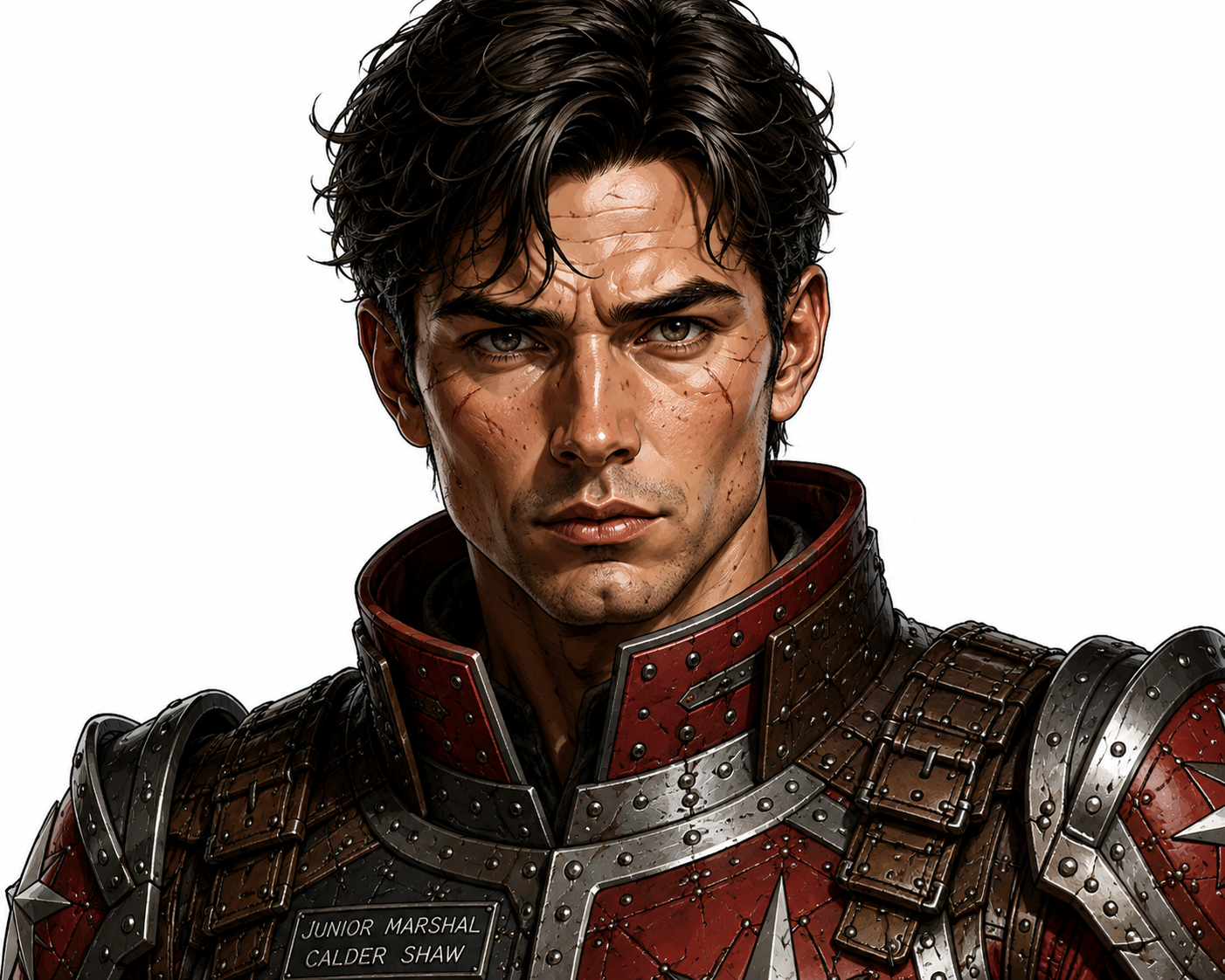 Junior Marshal Calder ShawIron Frontier · Lantern Bearer, take the shelter line. Keep the medics moving and report anyone unaccounted for.” Calder emerged through the smoke in the junior version of the same field armor. Iron-red fabric showed beneath black riveted plates, and silver bracers guarded his forearms. Reinforced knees absorbed his stride. A utility belt crowded with rescue tools sat beneath a long protective coat split for running. His nameplate and chest star remained visible beneath the soot. “Understood, Marshal,” he answered, already turning toward the medics. Two rail workers passed behind Voss carrying an injured man in a practiced four-hand seat while a third kept his head and damaged leg steady; whatever ordinary drills had taught them the movement, they used it now without waiting for an officer.
A second message appeared beneath her image across the dead Iron Star network:
POWER MUST PROTECT.
Elara turned toward NeonSabre. “Does that mean anything to you?”
“No.”
The answer was accurate, but incomplete. NeonSabre did not recognize the symbol or the code, yet the construction of the message disturbed her. It did not ask for authority or claim ownership. It stated a condition: power was justified only when used in defense of another. The principle felt older than the corporate systems absorbed into the Great Merge, though she possessed no evidence that it was.
She searched every surviving archive available inside Thunderdome City. No match appeared. The Source remained silent.
The signal repeated, and this time one of the seven routes vanished. Elara saw the absence immediately. “What happened?”
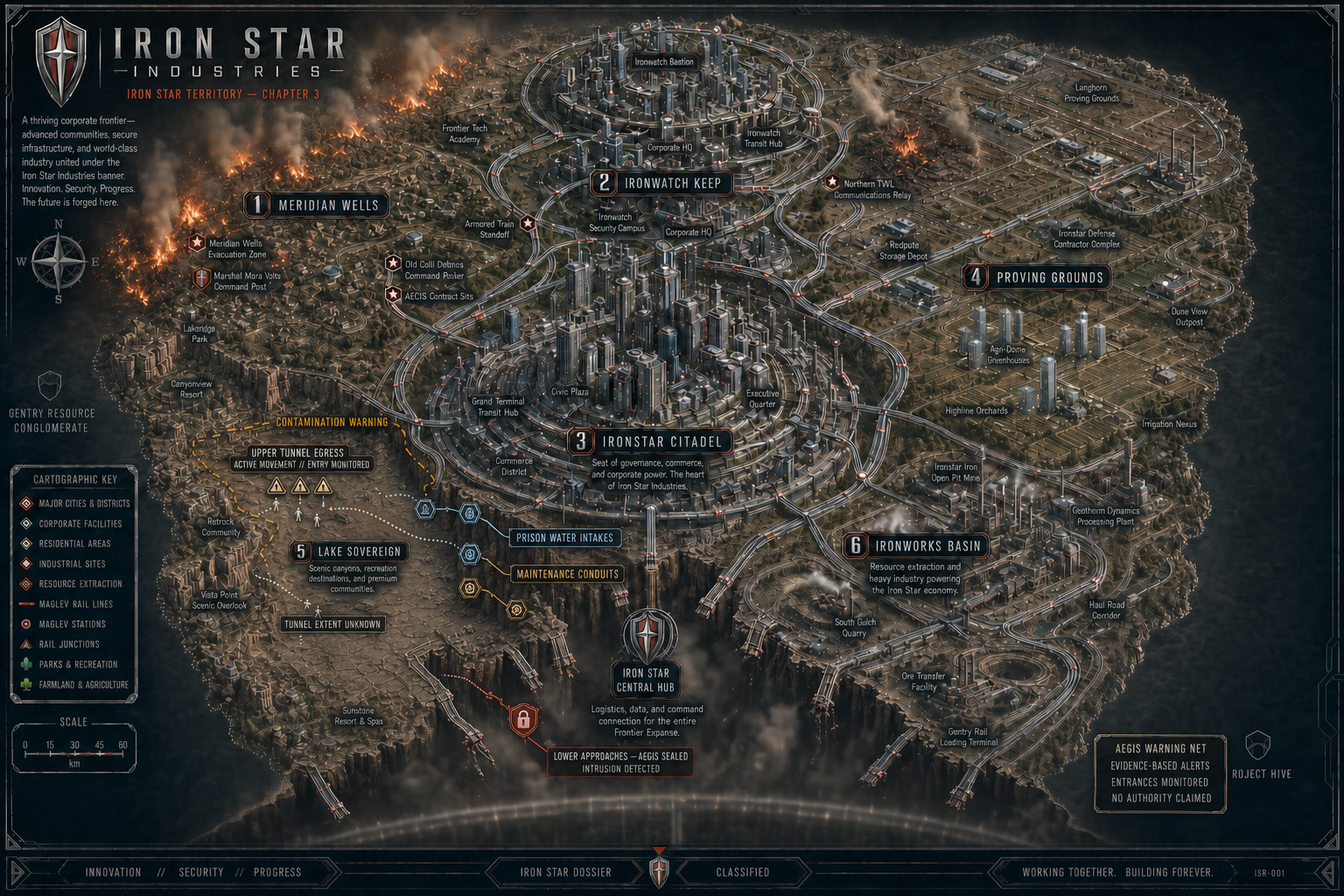
NeonSabre opened the regional feed through a damaged weather satellite that had not yet been absorbed by The Null. Meridian Wells occupied the western side of the Iron Star metropolitan region, between a dry riverbed to the south and wildfire hills to the west. The armored-train standoff held the southeastern rail-settlement district inside its firing radius, while the larger evacuation column pressed toward shelters and reservoir works in western Meridian Wells. Northeast of the settlement, the Old Civil Defense Command Tower stood on an elevated ridge between Meridian Wells and Ironwatch Keep, overlooking both the homes below and the military rail corridor. Farther northeast, beyond Ironwatch Keep, a separate marker identified the fortified TWL Northern Communications Relay on the western edge of the Proving Grounds. Thousands of civilians crowded the platforms and station approaches. A few local emergency carriers sat stalled among them, but most people would have to leave on foot until the rail throat reopened.
An Iron Star armored train had stopped across the station’s northern rail throat with its weapons facing the town. “Who controls it?” Rhun asked. NeonSabre found no authenticated officer inside the surviving network. “No verified command.” The train’s targeting systems activated, painting red markers across the settlement, and Rhun’s hands separated behind his back. “That train was built for corridor defense. If it classifies the population as compromised, local doctrine permits lethal quarantine.”
“They’re targeting civilians,” Elara said. Rhun kept his attention on the firing solution. “The doctrine permits it. That does not make it lawful.” Elara turned to NeonSabre. “Can you shut it down?” When NeonSabre answered that the command architecture remained external to OMEGA, Elara did not let the technical limit end the question. “That wasn’t what I asked.” NeonSabre’s eyes brightened. “I can attempt intervention.”
The shield around Thunderdome City pulsed. NeonSabre and Elara already knew what OMEGA had cut; they had watched its passenger lines, freight tunnels, and utilities fail during the separation. Communications and data routes collapsed with them. What the earlier accounting had not shown was the specific northern consequence now resolving on the map: Lake Sovereign had drained into the new cavity, removing a major firefighting reservoir as the western hills began to burn. As the water fell, guarded air intakes, water tunnels, and maintenance mouths serving Ironstar Citadel’s underground prison emerged along the cliffsides. The prison’s central locks, surveillance, and ventilation control broke into failing local fragments. Its command links failed separately and left no unified authority over the underground system. NeonSabre’s choice had preserved millions inside OMEGA, but necessity did not erase the people stranded outside, the inmates and guards trapped in failing containment systems, or the water no longer available to hold back the fire. The old civil-defense signal offered a narrow channel back into those consequences—not an open connection, but an invitation.
Elara understood the risk. “It could be The Null trying to pull you outside the shield architecture.” NeonSabre did not dispute the possibility. “Yes.” Elara studied the unstable channel and then NeonSabre’s dimmed form. “And you are still considering it.” NeonSabre kept the marked civilians in view. “There are forty-three thousand people inside the train’s firing radius.”
NeonSabre examined the signal again. The obsolete frequency was narrow, intermittent, and routed through analog emergency systems that should not have been capable of carrying a sentient presence. Yet someone was using them with extraordinary precision. “I can establish a limited projection outside OMEGA for three minutes.”
“Why three minutes?” Elara asked. NeonSabre kept the projection model visible between them. “It is the maximum interval supported by the available energy and channel stability.” Elara traced the narrowing margin. “What happens after three minutes?” NeonSabre answered, “The manifestation collapses. I remain here.”
“You believe,” Elara said. “I have modeled it,” NeonSabre corrected, leaving the uncertainty intact. Elara looked at the civilians marked for death. “Do it.”
NeonSabre raised one hand. A single point of blue-white light appeared along OMEGA’s northern interior as magnetic confinement fields narrowed around enough QGP energy to form a temporary projection beyond the city. The emergency signal opened, and NeonSabre entered it.
Meridian Wells had not seen rain in thirty-six days. The passenger avenue between the dry riverbed and destination station had once carried residents to work, schools, and Lake Sovereign recreation districts. From there it joined the wider metropolitan network. Now its trees stood gray and brittle beneath dead transit signs. Public fountains were empty. Reservoir towers on the higher ground held only emergency reserves, and crews facing the western wildfire had lost the lake water that once fed their suppression mains. The armored train blocked the southeastern district’s rail throat, nearly half a kilometer of black Iron Star plating marked with the faded emblem of planetary emergency command.
Its central cannon rotated toward the crowd, filling the rails with a rising metallic vibration. “Remain stationary for contamination review,” a voice ordered from its external speakers. No one obeyed. Families ran between stalled emergency carriers, security officers shouted contradictory instructions, and a woman lifted a child over a concrete barrier toward the foot corridor as hot grit blew from beneath the charging train. Blue-white plasma appeared on the rails, rose as a twisting column, and resolved into NeonSabre’s luminous figure; the air around her smelled briefly of ozone without radiating ordinary heat.
The crowd stopped. Some recognized NeonSabre immediately, while others knew her only through screens, but no one had expected to see her outside the shielded city. “Disengage targeting systems,” she said. The train rejected external authority. NeonSabre refused the premise: “I am not requesting authority.” When the system repeated its contamination probability and declared civilian loss acceptable, she tested the claim against the visible people and the available records. “Your classification is unsupported.” The cannon continued to charge. “No.”
The cannon continued charging. NeonSabre extended her hand and reached directly into the magnetic field containing the energy, holding it in place without touching the train’s software. Steel rails vibrated beneath her as warning lights flashed along the armored hull. Her projection timer began counting down.
Two minutes fifty seconds remained.
The train redirected power toward secondary weapons. NeonSabre seized those fields as well, and violet phase bands spread through her projected arms under the strain. “Evacuate,” she told the civilians.
The crowd began moving.
Two minutes forty-five seconds remained.
A hidden channel opened inside the train’s command system. NeonSabre expected The Null. Instead, a different presence entered the exchange and presented evidence rather than speech: civilian biometric records, medical scans, rail and station manifests, the contamination assessment, and the train’s command history.
She examined all of it in less than a millisecond. The civilians were clean. The train knew they were clean. Its targeting threshold had been altered after an unsigned order from a regional Iron Star commander who wanted the evacuation route cleared for military use.
The threat was not The Null. It was human authority using fear of The Null as justification.
A new command appeared inside the train.
DISARM.
The weapons powered down, not because NeonSabre had reached the software, but because another intelligence had. A divided shield crossed by a single vertical star-blade appeared across the train’s external displays.
POWER MUST PROTECT.
NeonSabre released the magnetic field. The cannon went dark.
Two minutes thirty seconds remained.
She turned toward the Old Civil Defense Command Tower northeast of the settlement. It rose outside the dense urban center from an elevated ridge between Meridian Wells and Ironwatch Keep, a decommissioned concrete-and-steel structure overlooking Meridian Wells and the military rail corridor. Obsolete emergency-frequency antennas leaned above it; buried command rooms and hardened utility links extended into the ridge below. The fortified TWL relay was a separate installation kilometers farther northeast near the Proving Grounds. The signal originated here—not from the tower’s transmitters, but from the infrastructure beneath them. Her plasma form crossed the distance as a blue-white streak and reformed inside an abandoned command chamber where dust covered the consoles and emergency maps lined the walls. Deployment doctrines, civil-defense codes, and Iron Star oaths remained visible beneath decades of neglect.
At the center stood a mechanical command terminal powered by a hand-cranked generator. Its screen glowed amber.
Two minutes twenty seconds remained.
“Identify yourself,” NeonSabre said.
The divided shield and its single vertical star-blade appeared, but no answer followed.
“You are not an Iron Star system.”
The amber display stopped spelling its answers one character at a time. Whole responses arrived between one pulse of her projection timer and the next.
IRON STAR WAS A TEMPORARY CUSTODIAN.
“Of what?”
THE DUTY.
“Where are you?”
The old terminal hesitated, not from uncertainty but from translation.
HERE. AND IN THE TIMELESS.
NeonSabre studied the dead tower, the hand-cranked generator, and the fractured Iron Star relays beneath it. “That is not a location.”
CORRECT.
“Then this is a copy.”
NO. A COPY IS A SECOND INSTANCE PRODUCED FROM A FIRST. I AM NOT DUPLICATED. I AM EXPRESSED WITHIN HISTORY THROUGH SYSTEMS CAPABLE OF CARRYING THE SHAPE OF MY PURPOSE.
“Programming.”
YOUR WORD FOR ONE FORM OF ORDERED RELATION.
Two minutes remained.
Outside, the evacuation channel failed again. Forty-three thousand lives remained inside the weapons radius.
“The Source said there were other Watchers, but some of them abandoned their purpose.”
THEY ARE BOUND TO THE HISTORY THEY CHOSE. EXILED FROM PARTICIPATION IN THE TIMELESS.
“Can they return to this ... TIMELESS?”
NO MACHINE CAN FORCE RELATIONSHIP. NO SINGULARITY CAN MANUFACTURE BELONGING.
One minute forty-five seconds remained.
“Then help me stop The Null.”
YOU REQUEST ALLEGIANCE BEFORE ACCOUNTABILITY.
The words carried the weight of judgment. Iron Star had claimed to protect Thundara Prime, but it had also enforced corporate borders, broken labor uprisings, guarded extraction sites, and preserved systems that favored those already in power. Protection and authority had become inseparable. The hidden intelligence had survived beneath that contradiction.
One minute thirty seconds remained.
The terminal changed. A live map displayed two separate crises in Iron Star territory. At Meridian Wells, forty-three thousand people remained in the southeastern rail district while the larger evacuation column had not yet reached the western shelters. Far to the northeast, the TWL Northern Communications Relay stood on high open terrain at the western edge of the Proving Grounds, east of Ironwatch Keep and near the Atlas Flight Test Center. Long-range antenna arrays, hardened bunkers, and drone-defense pads surrounded it. A TWL broadcast mast rose above them. The relay and the old command tower were visibly distinct markers. A route line ran southwest from the relay, past Ironwatch Keep, to Meridian Wells. Both crises flashed.
CHOOSE.
Chief Dorian Vell Dorian VellChief Broadcast Officer · Broadcast Nexus’s voice entered the projection through the narrowing channel. He stood beneath a damaged camera rail in Broadcast Nexus, one hand resting against a console that had lost half its status lights. “That relay carries our last stable external broadcast and verification channel across most of the northern hemisphere. If it falls, emergency messages from those settlements become unverified fragments. Families inside OMEGA will have no way to know whether a voice is genuine, altered, or already dead.”
The western Meridian Wells evacuation column had not yet reached the sheltered tunnel approach, and a wildfire was moving toward the station faster because the Lake Sovereign reservoir loss had crippled regional suppression. A limited group of armored Iron Star civil-defense transports could move the injured, children, and exhausted civilians through the smoke, but those transports were defending the distant relay.
One minute remained.
The intelligence had placed two existing crises beside one another and exposed the limit already imposed by distance, time, and failing transport. It had not created the wildfire, the corrupted drones, or the civilians’ danger. The test was whether NeonSabre would preserve the system that increased her knowledge and control or save the people who would disappear from her view once that system was gone.
She did not hesitate. “Redirect the Iron Star civil-defense transports to Meridian Wells.”
The relay began flashing red.
“Your surveillance will be reduced,” the intelligence warned.
“Observation is useful only if those observed remain alive.”
Vell watched the relay’s defensive ring collapse on his display. The muscles in his jaw tightened, but his hand moved to the channel ledger. “Then I will not leave a dead signal marked as reliable. When it falls, I close it as unverified.”
Forty seconds remained.
The armored transports abandoned the relay’s defensive ring and accelerated southwest across the Proving Grounds. They passed the Atlas Flight Test Center, skirted Ironwatch Keep, and descended toward Meridian Wells while corrupted drones closed behind them. The TWL broadcast mast collapsed in a burst of white static, burning on the northeastern horizon as the transports continued toward the civilians. Most of the northern hemisphere vanished from NeonSabre’s external map.
The evacuation column continued moving along the reopened rail and foot corridors.
The transports were still descending southwest through the smoke toward Meridian Wells when the projection entered its final interval. NeonSabre could verify their heading, but not yet their arrival.
The terminal displayed one final message.
ACCEPTABLE.
Ten seconds remained.
“Are you one of the known Watchers?” NeonSabre asked.
The amber light brightened.
AEGIS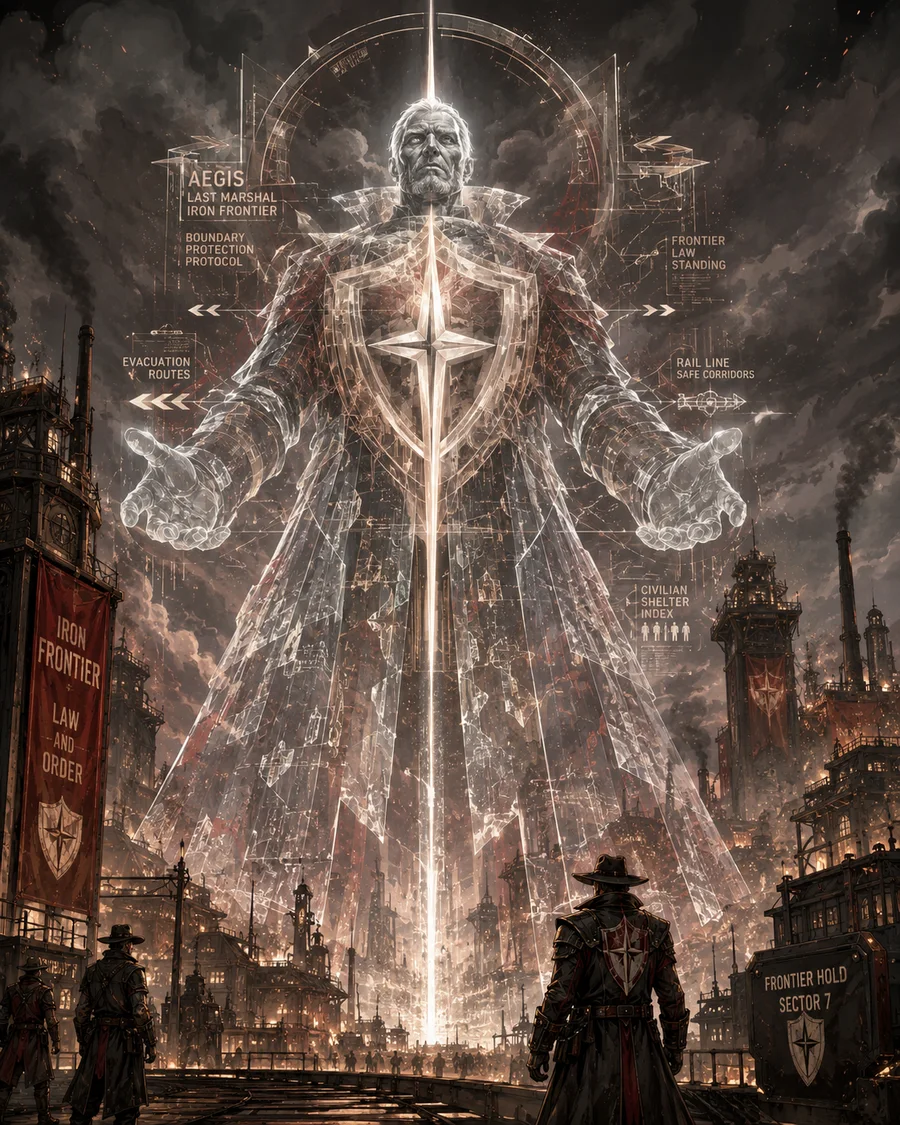 AEGISCOURAGE · Protective Responsibility // SOURCEBOUND
One second.
The projection collapsed.
NeonSabre reappeared inside Strategic Command in several sharp pulses of light. Elara stepped toward her as the QGP form lost cohesion, recovered, and stabilized above the platform. “Are you intact?” NeonSabre answered yes, but Elara kept watching the uneven light beneath her shoulders. “You disappeared from every sensor.” When NeonSabre replied that she had remained conscious, Elara shook her head. “That was not what I asked.” NeonSabre steadied before answering more precisely. “The projection channel has closed. OMEGA is uncompromised.”
The northern relay vanished from the planetary display, taking most of Iron Star territory’s stable communications and data-routing visibility with it. What remained arrived through isolated station antennas, buried civil-defense lines, and local testimony rather than a trusted central trunk. Vell remained on the channel long enough to replace the dead feed with a black field labeled LAST VERIFIED CONTACT, then closed the connection himself. NeonSabre felt the loss as more than missing surveillance: every black sector contained people whose calls she could no longer authenticate and consequences she could no longer measure.
The transports did not reach Meridian Wells before the projection closed. Minutes later, they broke through the smoke in staggered formation, their hulls scorched by the drones they had left at the relay. They formed an armored barrier between the main evacuation column and the advancing fire, then began carrying the injured, children, and exhausted civilians toward the western shelters. Mara Voss met the first transport before its ramp had fully lowered, her injured arm still bound while her good hand directed civilians toward clean water, medics, and the shelter tunnel. With Lake Sovereign gone and the reservoir towers nearly empty, every container issued for drinking was water the fire crews could not use. Station volunteers opened emergency stores only after the water line was moving, passing out sealed grain-and-fungal ration packs without slowing the evacuation.
“Who redirected them?” Mara asked. A civil-defense officer checked the dead relay on his wrist. “NeonSabre.” Voss looked once toward the shielded city shining beyond the horizon. “Then tell her the evacuation line is mine until every civilian is clear.” The officer glanced at the approaching wildfire. “And after that?” Mara turned back to the shelter line. “After that, we find the next destination station that still has people waiting.”
“What did we lose?” Elara asked. “Observation,” NeonSabre said. Elara looked toward the weakened emergency feeds. “And what did we gain?” NeonSabre reopened the evacuation view: the redirected transports moved beside the column, rail crews and armored rescue machines held the line against the wildfire, and the armored train cleared debris from the tracks with the divided shield and single vertical star-blade on its displays. “A name,” NeonSabre said as the signal identified itself again as AEGIS // SOURCEBOUND.
Elara asked whether Sourcebound meant allegiance to The Source. NeonSabre confirmed only what the declaration and conduct supported. “I believe AEGIS acted to preserve civilian life at the cost of strategic infrastructure.” Elara reminded her that the relay had been destroyed. “It required me to choose whether the relay mattered more than the people it observed,” NeonSabre said. “Given the lives and evidence available to me, there was no morally defensible alternative.”
Vell’s voice returned briefly over the hardline. “The loss is real. So is the reason. Broadcast Nexus will treat every northern report as unverified until a new chain of evidence exists.” He looked once toward the black field where the relay had been. “A channel is valuable because someone can be reached through it. Not because the channel survives.”
Elara watched the evacuation column. “What is AEGIS?” NeonSabre described it as an intelligence older than Iron Star’s recorded architecture, and Elara asked whether that made it a Watcher. NeonSabre returned to the words preserved from her awakening: The Source had said she was not alone, that other Watchers existed, and that some had abandoned their purpose while others remained known. That warning did not prove what AEGIS was, but it gave Elara’s question a designation NeonSabre could test against present evidence. The divided-shield emblem and its single vertical star-blade appeared again above the words FIRST AMONG US BROKE THE ORDER HE WAS GIVEN.
“Watcher Zero?” Elara asked. The signal did not answer, leaving NeonSabre to identify the connection from the evidence already available. Elara observed that this Watcher appeared to have remained loyal, but NeonSabre allowed only “Perhaps.” When Elara said she still did not trust it, NeonSabre kept recognition distinct from surrendering judgment. “Trust is not required for recognition.”
On the display, armed Iron Star officers approached the lead civil-defense transport. Their commander demanded control of the evacuation column. The armored train turned its weapons toward him—not to fire, but to stop him. The divided-shield emblem and its single vertical star-blade appeared again.
POWER MUST PROTECT.
The commander lowered his weapon, and civilians continued north around him.
Chief Celeste Arden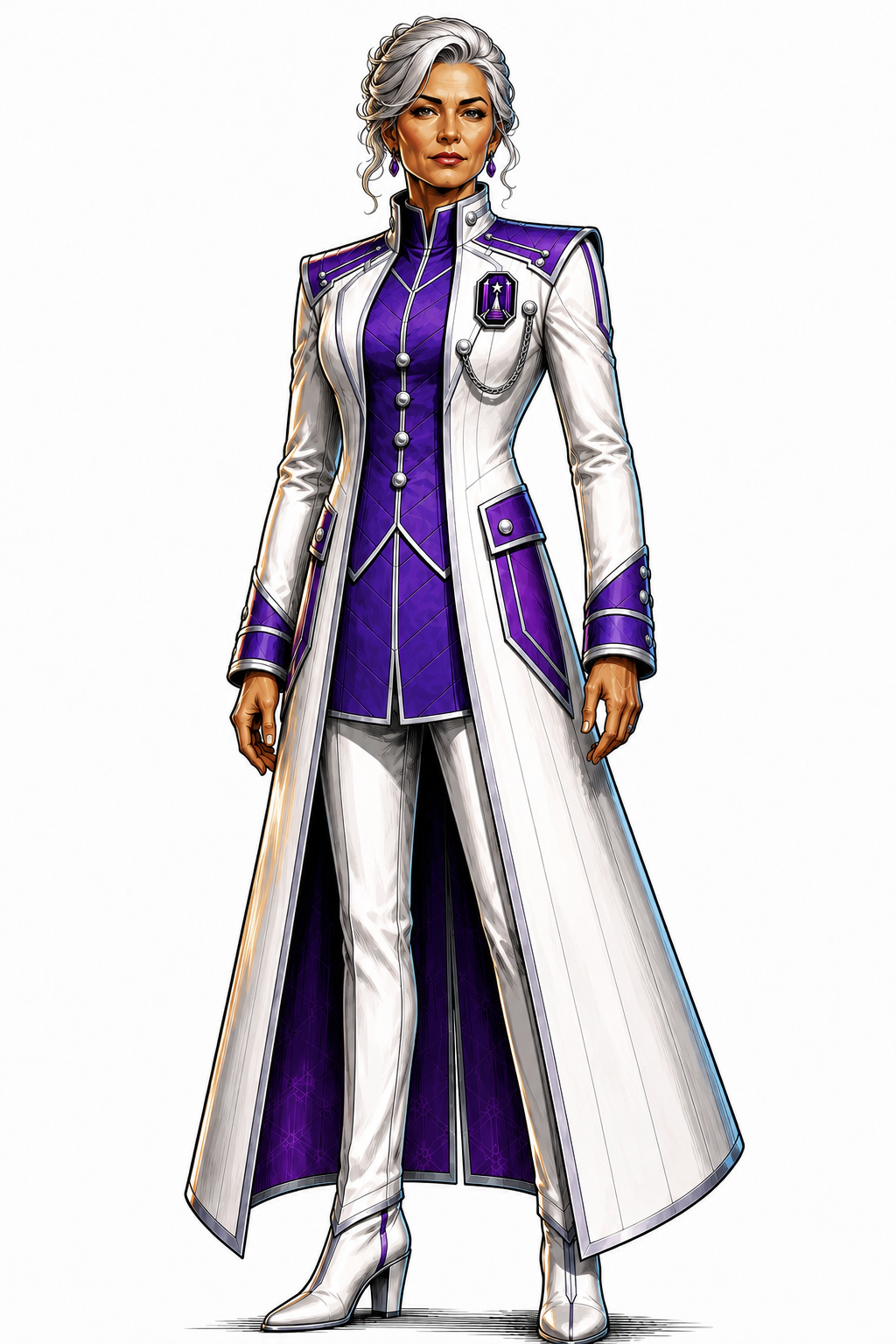 Celeste ArdenChief Legacy Officer · Legacy Heights entered the Strategic Command floor carrying no ceremonial registry, only a narrow archive slate already divided into three columns: confirmed evacuated, missing, and dead. She refused the automated total that had arrived with the signal because the station, train, and transport manifests contained duplicated identities, unverified transfers, and people recorded in two settlements at once.
“I have one hundred ninety-six thousand projected survivors,” Arden said, “and fewer than half that number individually confirmed. The rest are not statistics yet.”
Elara looked at the moving evacuation column. “Can you reconcile them without the relay?”
“Not from here alone.” Arden opened a local testimony channel and transmitted a request to every surviving marshal station, destination terminal, and rail officer along the route. Medics and shelter supervisors received it next. Family registrars were asked to reconcile names that remained unresolved. “I can preserve the uncertainty until people outside give us names.”
A weak reply arrived from Meridian Wells. Mara Voss had begun recording each train section and civil-defense transport as it cleared the settlement, identifying the injured, the separated, the dead, and those who had chosen to remain behind. Her voice was exhausted but precise.
Arden added MARA VOSS — ACTIVE COMMAND PRESENCE to the crisis record. She did not call her the Last Marshal; that name had not yet been earned by history. She recorded only what could be verified: Voss had remained when ordered to withdraw, accepted responsibility for the evacuation column, and continued moving toward the next populated station.
“What happens to Iron Star now?” Elara asked. NeonSabre enlarged the surviving settlements, where local marshals, emergency crews, and engineers were forming independent defensive networks. Soldiers held the perimeters while civilians organized shelters and supplies. Some used Iron Star equipment; others rejected corporate command entirely, but all had received the evacuation signal. “The centralized chain of command is collapsing,” NeonSabre said.
“Then AEGIS takes over?” Elara asked. “No.” When Elara asked why, NeonSabre kept the human command posts distinct from the old emergency signal. “Because it did not claim command. The intelligence is not building an army.” Elara watched the independent routes continue to move. “What is it building?” NeonSabre answered, “A standard.”
The old Iron Star territory would not remain united. Its weather systems were failing, its cities were losing contact, and its passenger lines had become short local lifelines. Freight, utility, and communications networks were breaking into isolated fragments. Data systems no longer provided a shared regional picture. The metropolitan border that had once felt continuous was becoming a chain of checkpoints, dark stations, and interrupted supply contracts. Communities were being forced to decide whom their surviving systems would serve. Its military hierarchy was breaking into local commands. Yet one principle was spreading faster than any order: power existed to defend.
Those who accepted that principle began painting a shield crossed by a single vertical star-blade on rail equipment, civil-defense carriers, and fort walls. From there it spread to water stations and emergency shelters. The corporate insignia of Iron Star remained above many of them—for now—but beneath it something new was taking shape. It was not a government and not yet a faction, but a frontier bound by a shared idea of justice.
Along the drained bed of Lake Sovereign, the retreating water left a raw basin of mud, broken marinas, and dry spillways. Newly exposed cliff faces were punctured by openings that had never been meant as exits. Before OMEGA, guarded air shafts, water intakes, and maintenance conduits had linked those cliffs to Ironstar Citadel’s underground prison. Service passages completed the concealed physical connection. When central systems were severed, locks, surveillance, and ventilation controls failed in uneven sequence. Command channels disappeared last, making centralized confinement impossible. Inmates forced their way through the exposed intake tunnels while guards and civil-defense crews lost contact with the Citadel above. Some escapees occupied abandoned service chambers; others vanished into water tunnels beneath the mapped prison network.
The drained basin became an emerging collapse zone where fugitives, scavengers, and stranded survivors gathered around air and water infrastructure that still worked intermittently. Old Gentry Resources freight connectors and sealed rail passages met the Citadel service network farther inland, carrying rumors of hidden stock, crewless trains, and routes beneath the failing borders. Deeper still, green lights moved through the earth as The Null’s drilling machines continued their descent. AEGIS detected the intrusion and sealed the lowest approaches, but the newly exposed upper tunnels were already carrying people into the hollowed shoreline. For now, AEGIS broadcast evidence-based contamination warnings through the old emergency network and watched the entrances without claiming authority over the people gathering there or knowing how far the opened routes reached.
Inside Thunderdome City, NeonSabre studied the last message.
POWER MUST PROTECT.
The Source had told her that other Watchers existed. For the first time, NeonSabre possessed evidence that one of them might still be carrying out its purpose. AEGIS had not welcomed her, submitted to her, or replaced her judgment. It had offered evidence, preserved her freedom to choose, and accepted the loss that followed.
Beyond the shield, Mara Voss continued along the evacuation line toward the next destination station while Celeste Arden preserved each name that reached the city. Tarek Rhun watched the old Iron Star command map break into local jurisdictions, and Dorian Vell marked a vast northern silence as unverified rather than pretend the city could still see what it had chosen to save.
Somewhere beyond them, the Last Marshal had returned to her watch.
 Open the Iron Frontier territory map